
A school excursion is ordinarily planned as an opportunity for learners to leave the classroom, experience new places and connect lessons with the world around them. For families and the King David Junior School community, however, a visit to Sipi Falls ended in an immeasurable loss.
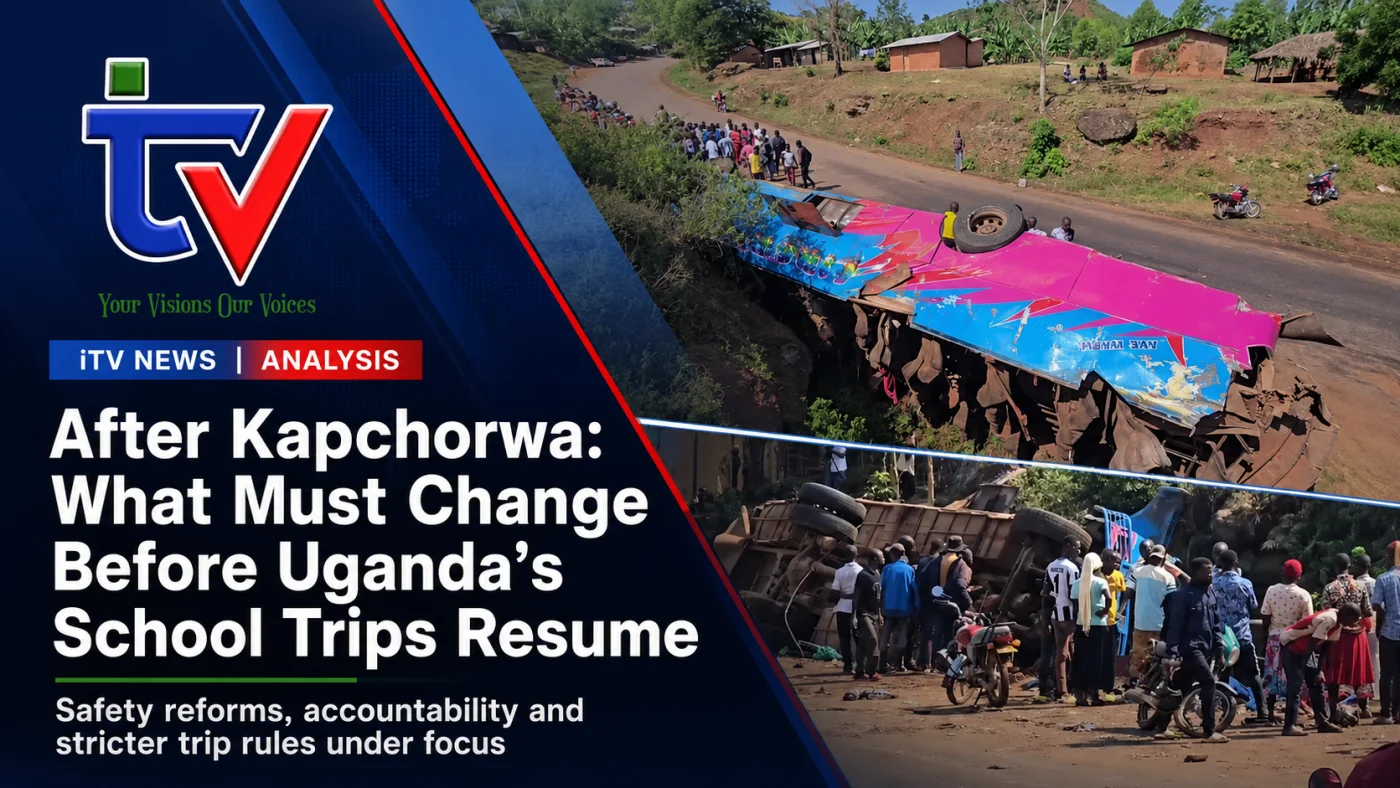
The bus carrying pupils and staff back towards Kampala crashed at Chekwatit Village along the Kapchorwa–Mbale Road on the evening of 16 July 2026.
According to the latest update from the Uganda Police Force, 24 people, including the bus driver, lost their lives. Other pupils and members of staff sustained injuries, while investigations into the cause of the crash remain ongoing.
The national response was immediate. The Ministry of Education and Sports suspended all school trips and educational excursions until further notice, creating space for investigations, a review of existing policy and the development of stronger safety requirements.
The suspension may temporarily remove learners from the roads, but the more difficult responsibility is ensuring that educational trips can eventually return without exposing children to avoidable danger.
What police have confirmed
Police said the Isuzu bus was transporting pupils and staff of the Kampala-based King David Junior School following an educational visit to Sipi Falls.
Preliminary information released shortly after the crash indicated that the driver lost control, after which the vehicle left the road, struck a large stone and overturned.
That account remains preliminary. Investigators have not yet issued their final findings, and it would therefore be irresponsible to declare mechanical failure, speeding, fatigue, road conditions or any other factor as the confirmed cause.
The school group had reportedly left Kampala at approximately 5:00 a.m. using two buses and two smaller vehicles. Police said the vehicles that were not involved in the crash returned safely with their occupants.
The tragedy affected children, staff, parents, relatives, first responders and communities that assisted at the scene. Reporting and public discussion must therefore avoid circulating distressing images, unconfirmed lists of victims or speculation that could deepen the suffering of affected families.
Uganda already had school-trip requirements
The Kapchorwa tragedy did not occur in the absence of policy. Uganda already had requirements intended to regulate educational trips and other off-campus school activities.
Guidance publicised by the Ministry of Education in 2025 required school travel to conclude by 6:00 p.m. It also required schools to submit planned stopovers and accommodation arrangements in advance.
Kindergarten pupils were prohibited from participating in such trips, while learners in Primary One to Primary Three were to travel only under exceptional circumstances and with close supervision.
Following the Kapchorwa crash, the Ministry further reminded schools that educational trips should involve prior risk assessment, the necessary administrative approvals, communication with parents and guardians, adequate teacher-to-learner supervision and transport arrangements that avoid overnight travel.
Drivers are also expected to be properly rested before undertaking journeys involving learners.
The existence of these requirements raises an important question: is Uganda’s main problem the absence of rules, or the failure to verify and enforce them before vehicles carrying children leave school premises?
Warnings had already reached Parliament
Concerns about the organisation of school trips had been raised in Parliament nearly a year before the Kapchorwa tragedy.
In August 2025, legislators demanded stronger regulation after two pupils from Daystar Junior School died and 11 others were seriously injured while returning from an excursion to Kasese District.
Kalungu West Member of Parliament Joseph Ssewungu questioned the age of children being taken on long journeys, the timing of travel and the level of planning and authorisation required.
Speaker Anita Among also raised concerns about unsafe transport arrangements, including reports of learners being carried on lorries, and questioned whether costly excursions discriminated against children whose parents could not afford additional charges.
Those warnings showed that school-trip safety was already a national concern. The Kapchorwa crash has now increased the urgency of moving from public statements to a system in which responsibility can be traced and compliance demonstrated.
A vehicle should not be cleared by appearance alone
Before school trips resume, the government will need to establish a dependable system for confirming that every vehicle carrying learners is roadworthy.
A bus may appear clean and presentable while still having defects involving brakes, tyres, steering, lights, seat anchorage or other safety systems.
Routine inspection certificates may also be insufficient for long-distance school travel if the vehicle is not examined close to the date of departure.
The post-Kapchorwa review should therefore define who inspects a school vehicle, how recently the inspection must have been conducted and how schools, parents and enforcement officers can verify that the certificate is genuine.
Schools that hire vehicles should not be permitted to transfer all responsibility to transport companies. The institution organising the journey retains a duty to confirm that the vehicle is licensed, insured, mechanically suitable and authorised to carry the stated number of passengers.
Passenger numbers must also remain within the lawful capacity of the vehicle. Overloading can affect stability, emergency evacuation and the severity of injuries when a crash occurs.
Driver competence must go beyond possessing a licence
A valid driving licence is essential, but it does not by itself prove that a driver is prepared for every journey.
Long-distance school trips may involve steep terrain, unfamiliar roads, night-time conditions, changing weather and the physical pressure of driving for several hours while responsible for many young passengers.
Schools and transport providers should be required to verify a driver’s licence category, professional experience, medical fitness, recent working hours and familiarity with the planned route.
A journey that begins before sunrise and continues into the evening creates legitimate questions about fatigue, rest periods and whether one driver should handle the entire route.
The Ministry of Works and Transport has since proposed an electronic clocking system for public-service vehicle drivers. The planned system would record journeys, working hours, rest periods and possible speeding.
Transport officials have also proposed stronger medical examinations, improved driver testing and digital verification systems capable of identifying unlicensed vehicles and unauthorised drivers.
These proposals could improve accountability, but their value will depend on implementation, access to reliable records and enforcement beyond major bus terminals.
Every trip needs a documented safety plan
Educational value should remain the foundation of every school trip. Schools should be able to explain why the journey is necessary, which learners are participating and how the destination relates to their education.
Beyond the learning objective, each trip should have a written safety plan covering the full journey from departure to return.
- The route, planned stops and expected arrival time should be recorded in advance.
- Parents or guardians should receive accurate information and provide informed consent.
- A complete passenger register should be available at the school and inside each vehicle.
- Emergency contacts for every learner should be readily accessible.
- Teachers and supervisors should be assigned clear responsibilities.
- First-aid supplies and personnel capable of providing basic assistance should be available.
- The nearest health facilities and police stations along the route should be identified.
- A procedure should exist for reporting delays, vehicle problems or route changes.
Such records should not be treated as paperwork completed merely to obtain approval. They should be practical documents that guide decisions throughout the journey and become immediately available during an emergency.
Supervision cannot end when learners board the bus
Teacher supervision is often discussed in terms of maintaining discipline, but it is also a safety responsibility.
Supervisors should confirm the passenger register, monitor seating, discourage movement inside the vehicle and ensure that learners are not left behind during stopovers.
They should also be empowered to object when a driver appears tired, drives dangerously, changes the approved route or continues a journey despite a mechanical concern.
A teacher who raises a safety concern should not be overruled simply because returning late may inconvenience the school or increase transport costs.
Schools must also consider the ages, health conditions and support needs of participating learners. Younger children and children with disabilities may require additional supervision, accessible transport or individual emergency arrangements.
Approval must involve real verification
Requiring approval from education authorities can strengthen oversight only when officials have enough information and capacity to conduct meaningful checks.
An approval system that merely receives a letter from a school without verifying the vehicle, driver, route, timing and supervision plan will provide little protection.
The government must determine which institution carries final responsibility for clearing a trip. This may require coordination among the Ministry of Education and Sports, district education offices, the Uganda Police Force, the Ministry of Works and Transport and vehicle-inspection authorities.
A digital record could help enforcement officers confirm whether a school group has been authorised, which vehicles were approved and who was registered to drive them.
Police should also have the power to stop or delay a school journey where the vehicle, driver, passenger numbers or travel conditions do not match the approved plan.
Dangerous routes require additional precautions
Not every Ugandan road presents the same level of risk. Mountainous areas, sharp bends, narrow sections, poor visibility and long distances require different planning from short urban journeys.
Road-safety audits should identify dangerous sections and ensure that warning signs, markings, guardrails and other protective measures are installed and maintained.
Schools planning travel through difficult terrain may require drivers with specific route experience, additional mechanical checks and schedules that ensure the most demanding sections are covered during daylight.
Weather conditions should also form part of the final decision to proceed. An approved journey should still be postponed where heavy rain, poor visibility, road damage or another immediate hazard makes travel unsafe.
Responsibility must be clearly shared
When a school trip ends in tragedy, responsibility can become fragmented among the school, vehicle owner, driver, inspector, education authorities and road agencies.
A stronger framework should clearly state what each actor is required to do and what consequences follow when those duties are ignored.
School administrators should be accountable for planning and verification. Transport companies should be accountable for providing safe vehicles and qualified drivers. Inspectors should be accountable for the integrity of their certification. Government authorities should be accountable for enforcement and the condition of the road network.
Parents should receive truthful information, but they should not be expected to independently investigate a vehicle or professional driver before consenting to a school activity. Those technical duties belong to institutions with the authority and expertise to perform them.
Educational trips should not disappear permanently
Educational excursions can contribute meaningfully to learning. Museums, farms, factories, cultural sites, conservation areas and geographical landmarks allow children to encounter subjects beyond textbooks.
A permanent ban would deny learners those opportunities without addressing the deeper failures that make some journeys unsafe.
The purpose of the current suspension should therefore be to rebuild the system around enforceable standards rather than quietly allowing trips to return under the same conditions after public attention fades.
Before the suspension is lifted, schools and parents deserve clear national guidance that can be applied consistently across public and private institutions.
That guidance should define vehicle standards, driver requirements, age restrictions, supervision ratios, maximum travel hours, approval procedures, insurance obligations and emergency planning.
A national test of whether lessons will be acted upon
The families affected by the Kapchorwa crash are carrying a loss that no policy review can reverse.
The most responsible national response is not speculation about the cause before investigations are completed. It is a commitment to establish what happened, communicate the findings honestly and ensure that every identified failure produces a measurable correction.
Uganda has previously mourned children lost during school journeys and heard demands for tighter regulation. The question now is whether the latest tragedy will finally produce a system that prevents unsafe vehicles, unprepared drivers and poorly planned journeys from carrying learners onto the road.
School trips should resume only when parents can reasonably trust that an excursion has been planned as carefully for safety as it has been planned for learning.