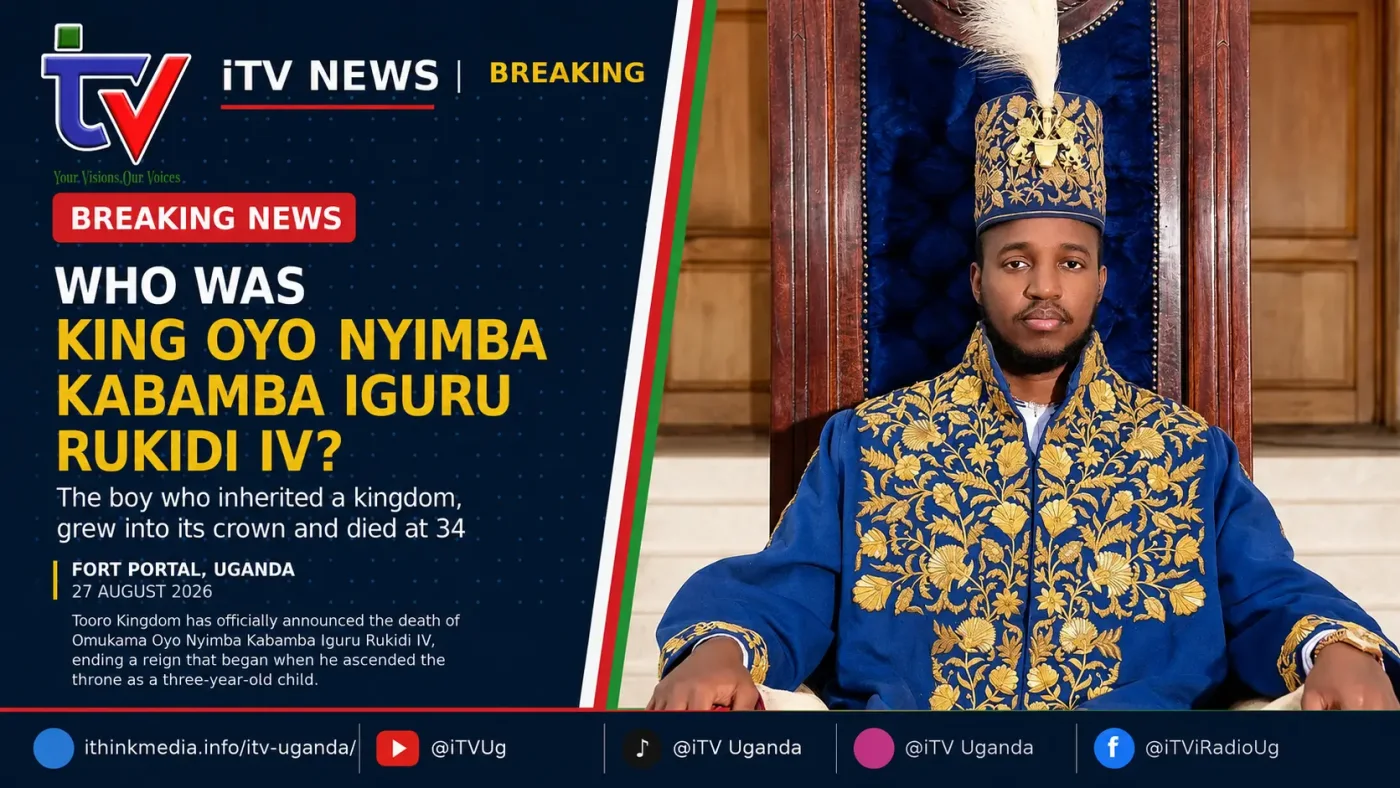
For nearly 31 years, Uganda watched a child grow into a King.
When Rukirabasaija Omukama Oyo Nyimba Kabamba Iguru Rukidi IV was born on April 16, 1992, there was little indication that his life would become one of the most extraordinary royal stories in modern Uganda. He was born into the Tooro royal family, the son of King Patrick David Matthew Rwamuhokya Kaboyo Olimi III and Queen Best Kemigisa.
Three years later, tragedy transformed the course of his life.
His father died suddenly on August 26, 1995. Oyo, then only three years old, became heir to the Tooro throne. On September 12, 1995, he was enthroned as Omukama of Tooro, becoming internationally recognised as the world's youngest reigning monarch.
He would spend almost his entire life associated with the crown.
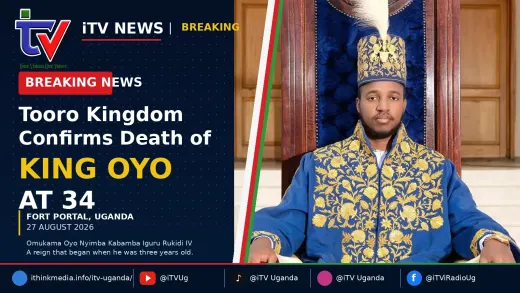
And on August 27, 2026, at approximately 10:00 p.m., that extraordinary journey came to an end in the United States. He was 34.
Born into the Babiito royal line
King Oyo belonged to the Babiito royal dynasty, the ruling house of Tooro.
His father was Rukirabasaija Patrick David Matthew Rwamuhokya Kaboyo Olimi III, who had been King of Tooro before him. Patrick Kaboyo was himself the son of Sir George David Matthew Kamurasi Rukidi III, who ruled Tooro from 1928 until 1965, and Lady Byanjeru Kezia Bonabaana. Patrick Kaboyo was the fourth son in that royal family, and his elder sister was the celebrated Princess Elizabeth Bagaaya.
That made Oyo the grandson of King Rukidi III.
On his mother's side, Oyo was the son of Queen Best Kemigisa, daughter of Prince Mujungu of the Batuku clan of Rwebisengo, in the area that is now Ntoroko District. His mother's family therefore connected the young monarch not only to the Babiito royal institution but also to one of the important communities within the wider Tooro cultural landscape.
Oyo was the second-born child of Patrick Kaboyo and Best Kemigisa.
His elder sister was Princess Ruth Nsemere Komuntale, now Princess Royal of Tooro. His younger sister, Princess Celia Komukyeya, died as a child after battling leukaemia in 1997.
The death of Celia was another devastating chapter in the family's history. Queen Best Kemigisa was still a young woman when she lost her husband and later her little daughter, leaving Oyo and Ruth as the surviving children of the immediate royal family.
The name Oyo Nyimba Kabamba Iguru Rukidi IV
The story behind his name is also deeply connected to Tooro tradition.
According to Omujwera Musuuga Charles Kamurasi, who played a major role in Oyo's childhood and enthronement, Oyo's father had already selected the names Oyo Nyimba Kabamba Iguru for his son before his birth.
The royal elders subsequently added the kingship name Rukidi IV, in remembrance of his grandfather, King Rukidi III.
Thus, the name that came to be known throughout Uganda and internationally was not merely a personal name. It carried the memory and continuity of the Tooro royal line.
A crown came before childhood
Oyo was born at Nsambya Hospital in Kampala on April 16, 1992. His father was at the time away on official diplomatic duties, having served as Uganda's ambassador to Cuba. According to Charles Kamurasi, Queen Best Kemigisa was pregnant when Kaboyo left for Cuba, and Kamurasi and Princess Elizabeth Bagaaya helped care for the young family.
But Oyo's childhood changed permanently in August 1995.
King Patrick Kaboyo died on August 26, 1995, leaving behind a three-year-old heir.
Tooro's traditional system required the institution of the monarchy to continue despite the child's age. The young prince was therefore prepared for the throne through a sequence of traditional rituals.
On the night of September 11, 1995, Oyo was carried from his father's residence towards Karuziika Palace. According to Charles Kamurasi, the royal procession encountered a ritualised resistance at the palace gate, symbolising the challenge that a new King had to overcome before entering the palace. Inside, Oyo participated in ancient ceremonies, touched the royal axe and struck the royal drum nine times. A royal dinner followed, involving members of the Babiito clan and royal household.
At sunrise, the young King sat on the royal stool, another ritual affirmation of his kingship.
The ceremonies continued with a service at St John's Cathedral before Oyo returned to the palace, where the crown was placed upon his head.
He was three years old.
The images of a tiny child dressed in royal robes quickly travelled beyond Uganda. The world became fascinated by the toddler who was now a King.
A King governed by regents
Although Oyo was the monarch, he was obviously too young to personally manage the affairs of the kingdom.
A regency system therefore guided the institution during his childhood.
His mother, Queen Best Kemigisa, played a central role. His aunt, Princess Elizabeth Bagaaya, and his uncle, Prince Jimmy Mugenyi, were also among those entrusted with his upbringing and the management of the kingdom's cultural affairs. President Yoweri Kaguta Museveni was also recognised as a guardian of the young King.
The arrangement meant that Oyo did something very few people in the world have ever experienced: he grew up while simultaneously growing into a crown that he had inherited before he could understand its meaning.
By the time he reached adulthood, he had already spent most of his life as King.
Growing up in Uganda and Britain
Oyo's education reflected both his unusual status and the efforts of the royal family to give him a broad upbringing.
The official Tooro Kingdom biography says that he was initially home-schooled, later attended Aga Khan Primary School, and subsequently studied at Kabira International School. It records that he studied Business Management at the University of Winchester in Britain from 2010 to 2013.
He also spent part of his childhood in Britain. Dennis Katungi, a family friend and former New Vision foreign correspondent, recalled meeting the young Oyo in London and visiting the school where the little King studied in Lewisham. Katungi later attended Oyo's graduation in 2013.
The young King eventually transitioned from being a global curiosity to being an educated adult monarch.
He graduated with a business degree in 2013, and the Tooro Kingdom says he later received an honorary doctorate in recognition of his work in HIV/AIDS advocacy.
At 18, the child King became an adult monarch
A significant turning point came in 2010, when Oyo reached the age of 18.
Until then, the regency had played the practical role of overseeing the kingdom while he was a minor. At adulthood, he increasingly assumed direct responsibility for his role as Omukama.
His 18th birthday was therefore more than a personal milestone. It marked the transition of a monarch who had been represented and guided during childhood into a King who could increasingly exercise his own responsibilities.
From that point, the young monarch began developing an identity of his own.
He was no longer merely the three-year-old King whose photograph had fascinated the world.
He was becoming a national cultural leader.
A King who made young people central to his reign
Youth became one of the defining themes of Oyo's adult reign.
He repeatedly encouraged young people to pursue education, vocational skills, entrepreneurship, agriculture and opportunities for self-employment rather than depending exclusively on conventional white-collar employment.
The official Tooro Kingdom biography records a number of initiatives associated with him, including a model farm intended to demonstrate responsible agricultural practices, youth sporting initiatives and efforts to establish an ICT centre in Fort Portal.
Agriculture became particularly important to his development agenda.
Through the kingdom's model farm in Bugaaki, the idea was to demonstrate practical farming methods that ordinary people could adopt regardless of the size of their land.
It was an approach consistent with the realities of the region, where agriculture remains central to household livelihoods.
His fight against HIV and AIDS
One of the most important national and international roles King Oyo assumed was in the fight against HIV/AIDS.
In 2016, at the age of 24, he was recognised by UNAIDS as a cultural champion for HIV and AIDS among young people in Eastern and Southern Africa. UNAIDS said he used his influence among young people to promote the prevention of HIV and the goal of ending AIDS as a public-health threat by 2030.
This was not simply a ceremonial appointment.
Oyo publicly spoke about the importance of preventing new HIV infections and stressed that men had a responsibility alongside women, particularly in preventing mother-to-child transmission of HIV.
UNAIDS, in its tribute following his death, remembered him as a leader who used his voice and influence to advance the fight against AIDS and to champion the future of young people.
Health became another pillar of his reign
King Oyo's interest in health extended beyond HIV/AIDS.
Under initiatives associated with the Tooro Kingdom, annual medical camps were organised around the Empango celebrations, providing services including HIV testing, cancer screening and medical procedures. A 2025 account in the Daily Monitor noted that such programmes had reached more than 1,200 people in a single year.
Even in April 2026, shortly before his death, the Kingdom organised a free corrective-surgery camp for children as part of activities marking his 34th birthday. Thirty children received surgery at Fort Portal Regional Referral Hospital.
That final birthday was therefore marked not primarily by celebration, but by service to children.
A King with a development vision
Perhaps the clearest expression of his long-term outlook was Tooro Kingdom Vision 2045, launched in 2021.
The 25-year development framework sought to promote socio-economic transformation and prosperity within Tooro, with priorities including youth skills, employment and wealth creation, agriculture, poverty reduction, health, tourism, environmental conservation and preservation of cultural heritage.
For Oyo, preserving culture did not mean keeping Tooro frozen in the past.
His model was increasingly about combining tradition with modern development.
That became visible in the Kingdom's engagement with agriculture, tourism, technology, health and youth empowerment.
The mountains, the environment and the Rwenzori
Oyo also used the symbolism of the monarchy to draw attention to environmental conservation.
In 2022, he led a Royal Rwenzori Mountain Expedition, intended not only to promote mountaineering and tourism but also to raise awareness about climate change and its effects. The Tooro Kingdom says a National Geographic documentary of the expedition was later premiered internationally in San Diego in 2023.
The initiative reflected another aspect of his reign: an attempt to connect Tooro's traditional identity and natural heritage with contemporary global issues.
A King who loved football
Away from ceremonies and development programmes, King Oyo was also known for his passion for sport, particularly football.
FUFA described him after his death as a true friend of the game and noted his support for the Uganda Cranes, the Tooro Kingdom Amasaza Cup and football development in the region.
He was also an enthusiastic supporter of the FUFA Drum, which uses football to celebrate Uganda's cultural diversity.
His sporting interests helped give the monarchy another avenue through which to connect with young people.
His relationship with President Museveni
Oyo's life and reign were closely intertwined with the administration of President Yoweri Museveni.
Museveni's relationship with the young King went back to the regency period, when the President was recognised as one of Oyo's guardians. The relationship continued throughout Oyo's adult life, with the President and the Tooro Kingdom working together on issues including development, tourism and the long-running question of kingdom assets.
The relationship also became especially important during Oyo's final illness, when Museveni said the government supported efforts to obtain specialised medical treatment abroad.
The unfinished question of Tooro's properties
King Oyo's reign was not without controversy.
One of the longest-running issues was the recovery of properties that had belonged to Tooro before the abolition of Uganda's traditional kingdoms in 1967.
After the kingdoms were restored in 1993, Tooro pursued the return of properties that had been taken over by the State. In 2013, Oyo directed his administration to intensify efforts to recover dozens of properties that remained under government control.
The issue continued throughout his reign.
In 2025, Oyo again met President Museveni and raised the matter of the return of Kingdom properties, alongside tourism and development issues.
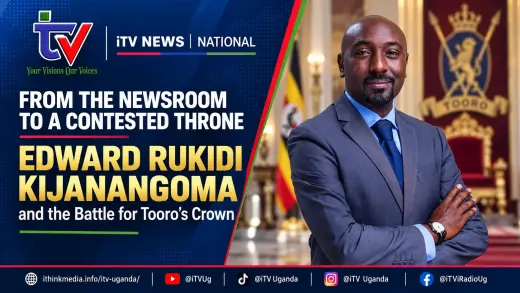
There were also periods of internal disagreement within the royal family over leadership and the management of Kingdom property. A significant dispute involved his cousin Prince David Kijanangoma, who challenged Oyo's leadership during the 2010s before peace efforts eventually reduced the confrontation.
These challenges formed part of the more complicated reality behind the public image of the young King.
A King who never publicly married
Oyo's private life remained unusually private.
Unlike many traditional monarchs, he never publicly installed an Omugo, or Queen Consort of Tooro.
Indeed, by 2025, his unmarried status had become a subject of public discussion. His mother, Queen Mother Best Kemigisa, publicly appealed to him to marry and give her grandchildren. Religious leaders and political figures also encouraged him to consider marriage.
At the 2025 celebrations marking 30 years of his reign, then-Speaker of Parliament Anita Among even jokingly offered to provide cattle for his bride price if he found a partner.
Oyo never publicly announced a wife.
But after his death, the question of whether he left a biological heir became one of the most sensitive issues surrounding the succession.
His final illness was kept largely private
King Oyo's final months were marked by a striking degree of secrecy surrounding his health.
In early August 2026, the Tooro Kingdom publicly rejected reports that he was critically ill with cancer, saying he was abroad for studies and official engagements.
By August 27, however, the Kingdom confirmed that the 34-year-old monarch was in critical condition in the United States and asked the public to pray for him.
Later that night, the Kingdom announced his death.
President Museveni subsequently revealed that Queen Mother Best Kemigisa had informed him in November 2025 about the King's illness and that the government had supported his treatment, first in Germany and later in the United States. Museveni described the illness as aggressive cancer.
Reuters subsequently reported that King Oyo died of cancer in the United States on August 27, 2026.
His death shocked the country partly because the seriousness of his illness had not been widely known.
The day the crown fell silent
On Thursday, August 27, 2026, at approximately 10:00 p.m., King Oyo died.
The announcement was made by Tooro Kingdom Prime Minister Calvin Armstrong Rwomiire Akiiki, who described the loss as immeasurable for the Royal Family, the people of Tooro and Uganda.
He was only 34 years old.
He had spent almost 31 years as King.
In fact, his death came only about two weeks before the date on which Tooro would have celebrated his 31st coronation anniversary on September 12.
The child who had inherited the throne in 1995 had therefore spent almost 90 percent of his life as the Omukama.
The mystery of the heir
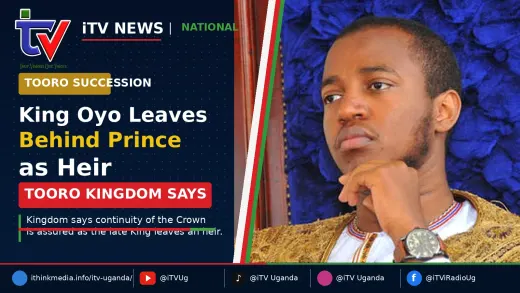
Immediately after his death, Tooro Kingdom announced that the continuity of the Crown was assured and said that King Oyo had left behind a Prince who would be his heir, although the identity of the Prince would be revealed at the appropriate time according to Tooro custom.
President Museveni also said Queen Mother Best Kemigisa had informed him that Oyo had left behind a young son who would eventually be introduced as heir.
However, the issue has since become contested.
Charles Kayondo Kamurasi, head of the Babiito royal clan and a key figure in the kingdom's traditional succession process, said the clan had no known biological child of King Oyo and that the succession process would therefore have to establish the facts. A 21-member committee of Babiito elders was subsequently constituted under the authority of the Musuuga to manage the traditional succession process.
For an iTV obituary, this distinction is important: the Kingdom and President Museveni have stated that an heir exists, but the identity and succession status have not yet been formally resolved in public.
His final journey home
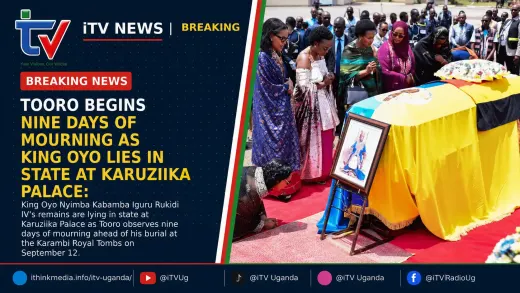
King Oyo's remains were returned to Uganda on September 4, 2026, arriving at Entebbe International Airport, where President Museveni, members of the royal family, government officials and religious leaders received the body.
The government took charge of the state-supported funeral arrangements.
His burial is scheduled for September 12, 2026, at the Karambi Royal Tombs in Tooro — the very date that would have marked 31 years since he ascended the throne.
The symbolism is profound.
The date that once marked the beginning of his reign will now mark the end of his earthly journey.
What King Oyo leaves behind
King Oyo's historical importance cannot be reduced to the fact that he became King at three.
His deeper story is what happened afterwards.
He inherited the crown as a child, grew up under public scrutiny, was educated in Uganda and Britain, entered adulthood as a monarch, and spent the greater part of his life trying to give meaning to a cultural institution in a modern Uganda.
He advocated for young people.
He used his influence in the fight against HIV/AIDS.
He promoted education, vocational skills, agriculture, health, tourism and sport.
He championed environmental conservation and the preservation of Tooro's heritage.
He promoted the Kingdom's Vision 2045.
And he remained a visible symbol of Tooro at national and international levels.
Perhaps that is the most fitting way to understand the life of Oyo Nyimba Kabamba Iguru Rukidi IV.
He was not simply the boy King of Tooro.
He was the boy who became a man under the crown.
He was the child Uganda watched grow.
He was the grandson of King Rukidi III, the son of King Patrick Kaboyo Olimi III and Queen Mother Best Kemigisa, the brother of Princess Ruth Nsemere Komuntale and the late Princess Celia Komukyeya, and the custodian of a royal institution whose history stretches back to the nineteenth century.
He inherited a kingdom at three.
He carried it for almost 31 years.
And at 34, his life ended — leaving behind a grieving mother, a royal family confronting another painful transition, a kingdom awaiting its next chapter, and a generation that had known no other Omukama.
King Oyo Nyimba Kabamba Iguru Rukidi IV died on August 27, 2026, but the story of the boy who became King will remain part of Uganda's history.
Omukama Atulize. Enkuba Etutire.