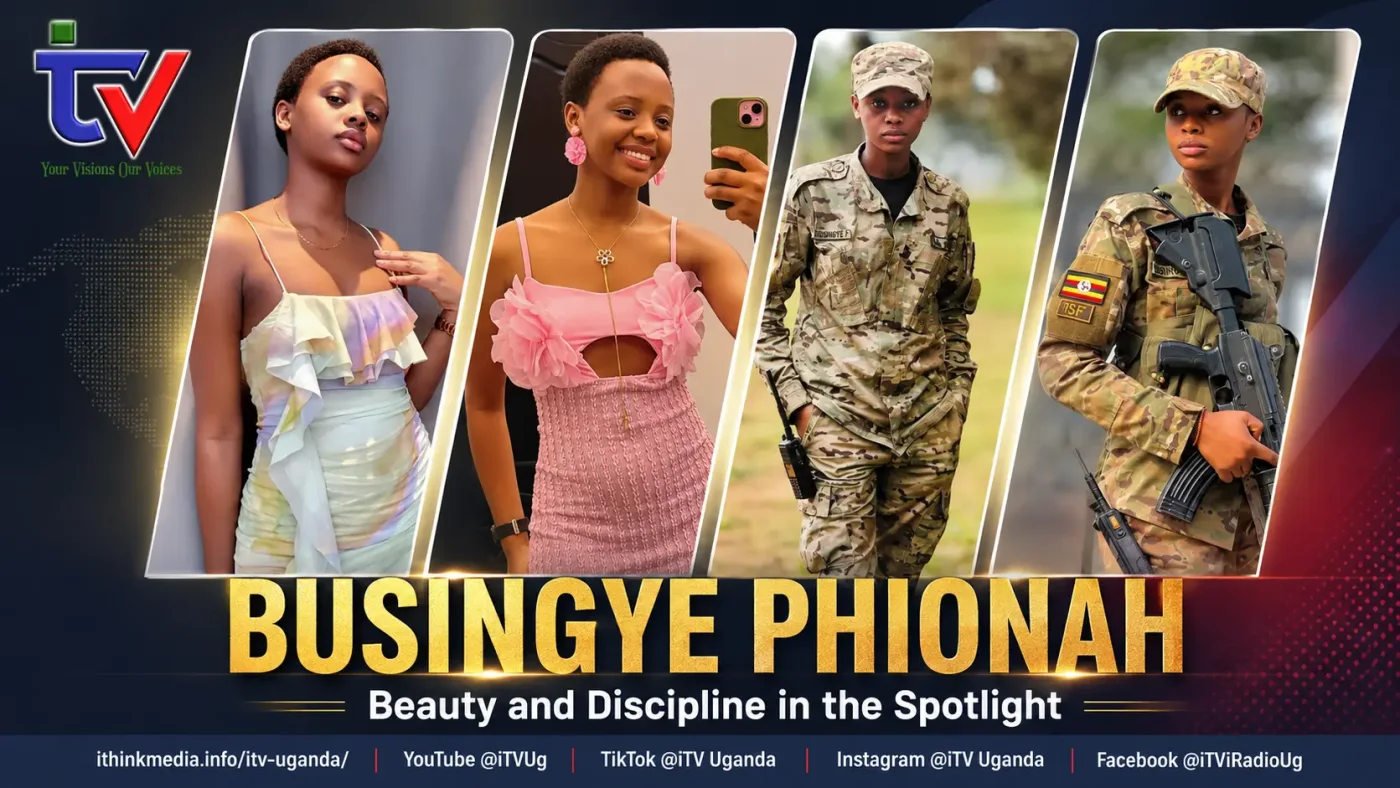
In one photograph, she stands in military fatigues and combat boots, composed and unmistakably disciplined. In another, she appears away from uniform in a flowing pastel dress, presenting an entirely different side of herself.
It is that contrast that has made images identifying her as Busingye Phionah travel widely across social media: soldier and young woman, toughness and elegance, military discipline and ordinary personal expression existing comfortably in the same person.
But reducing the conversation to beauty alone would miss the more important story.
The attention surrounding Busingye reflects a changing image of women in Uganda’s armed forces, where female personnel are increasingly visible as commanders, pilots, engineers, medics, peacekeepers, staff officers and combatants.
For a generation that grew up seeing military service presented overwhelmingly through male faces, the sight of young Ugandan women confidently wearing the uniform carries significance beyond social-media admiration.
The Woman Behind the Viral Images
Several social-media profiles circulating photographs of the young soldier identify her as Busingye Phionah and describe her as serving in the Uganda People’s Defence Forces.
The posts have attracted considerable public attention, often focusing heavily on her physical appearance and presenting her as an example of the increasingly visible generation of women in uniform.
The photographs supplied to the iTV Uganda Newsroom also show the name BUSINGYE displayed on military fatigues.
However, an official UPDF biography publicly confirming her rank, unit, military courses or operational deployment history could not be located by the time of publication.
Claims circulating online that assign her particular tactical qualifications, peacekeeping deployments or command courses should therefore not be presented as established facts unless independently confirmed by Busingye herself or the UPDF.
That absence of a detailed public service record does not diminish the wider significance of the attention she has attracted. Instead, it provides an opportunity to look beyond the individual and examine the institution in which women like her are increasingly serving.
Beauty and Military Service Are Not Contradictions
Much of the online conversation surrounding Busingye has centred on her appearance.
There is nothing unusual about audiences appreciating a public figure’s style or presence. The problem begins when appearance becomes the only measure through which a woman’s professional identity is understood.
A woman does not become less feminine by wearing military fatigues, nor does wearing a dress outside duty make her less capable of performing demanding professional responsibilities.
The two images can exist together.
That is perhaps why photographs such as Busingye’s resonate so strongly with younger audiences. They challenge the assumption that strength requires women to abandon femininity, or that femininity should be interpreted as weakness.
Military service demands discipline, physical preparation, obedience to lawful command, professional training and the willingness to work in difficult environments. None of those qualities belongs exclusively to men.
Women Are Taking Wider Roles in the UPDF
The Uganda People’s Defence Forces has publicly acknowledged the growing role of women across its structures.
According to the UPDF Directorate of Women Affairs, female personnel today serve in areas including command, aviation, engineering, medicine, logistics, social work and peacekeeping.
The force has also adopted affirmative-action measures intended to increase female participation during recruitment and deployment, including representation from tactical to strategic levels.
UPDF Director of Women Affairs Brig. Gen. Charity Bainababo has argued that greater female participation has improved both the representativeness and operational effectiveness of the force.
For the military, the issue is not simply the number of women wearing uniforms. It is whether women are receiving meaningful opportunities to train, lead, specialise and progress through the institution.
More Than 500 Ugandan Women Serving in Somalia
One of the clearest demonstrations of that transition can be found in Uganda’s international deployments.
UPDF officials reported in 2025 that the number of female Ugandan personnel serving in Somalia had grown from only three women during one of the early battle groups to more than 500 serving in various capacities.
Those roles include commanders, staff officers, pilots and other military personnel supporting Uganda’s contribution to peace and stabilisation operations.
During engagements with female troops in Somalia, UPDF women-affairs officials have repeatedly emphasised professional education, military courses, technology, discipline and leadership development.
The message is significant: women are not being presented merely as symbolic additions to the armed forces. They are expected to train, perform and progress professionally alongside their male colleagues.
Breaking a Long-Standing Stereotype
For generations, African military imagery has been dominated by men.
Women were frequently presented as wives waiting for soldiers to return home, nurses tending to the wounded or civilians affected by conflict rather than as trained personnel participating directly in national defence and peace operations.
That image has changed steadily.
Uganda has produced senior female military leaders and women serving in technical and operational roles that would once have been regarded almost exclusively as male professions.
Lt. Gen. Proscovia Nalweyiso became one of the most prominent examples of female military leadership in Uganda, while successive generations have entered aviation, medicine, engineering, communications, legal services and field operations.
The visibility of younger women in uniform continues that transition.
A photograph may appear simple, but for a schoolgirl who has never imagined herself becoming a military pilot, doctor, engineer or commander, seeing another woman occupying that space can quietly expand what she believes is possible.
Visibility Comes With Responsibility
Military personnel occupy a different position from entertainers, influencers and other public personalities.
Uniform represents the state and carries responsibilities involving discipline, confidentiality, professional conduct and institutional rules.
Social-media visibility can therefore be both an opportunity and a challenge for serving personnel.
Public attention can inspire others and humanise institutions that citizens often encounter only through official statements or security operations. At the same time, military personnel must remain conscious of operational security, personal safety and the regulations governing what serving members may disclose publicly.
For audiences, responsibility also matters.
Female soldiers should be discussed with the same dignity afforded to male personnel. Admiration should not become harassment, sexualisation or speculation about a woman’s private life simply because photographs of her have attracted attention.
The Uniform Does Not Erase the Person
One of the most striking things about the images attributed to Busingye is how ordinary one side of them is.
A soldier can finish duty and still enjoy fashion. A commander can be a mother. A military pilot can enjoy music. A combatant can laugh, worship, study, marry, raise children or spend time with friends.
The uniform represents professional responsibility; it does not erase personality.
Recognising that humanity is particularly important when discussing women in professions traditionally associated with toughness.
Women should not have to become caricatures of masculinity to prove that they belong in the military.
They should be assessed by the same standards that ultimately matter for every soldier: discipline, competence, integrity, preparedness and service.
A New Generation Watching
Busingye’s photographs may have first caught attention because people found her striking.
But their lasting value may lie elsewhere.
They belong to a wider visual record of Ugandan women entering spaces once considered unusual for them and doing so without surrendering their individual identities.
The UPDF itself says its female personnel are increasingly serving in demanding environments and that women’s participation has strengthened representation within the force.
There are still challenges. Senior UPDF officials have publicly acknowledged continuing concerns involving social stereotypes, sexism and sexual harassment, even as the institution works to increase women’s participation.
Real progress therefore cannot be measured by attractive photographs or recruitment numbers alone.
It must also be measured by whether women receive fair access to professional courses, promotions, leadership positions, specialised assignments, safe working environments and the institutional support required to build long military careers.
Beyond Busingye
Busingye Phionah may be the face currently attracting social-media attention, but the deeper story belongs to thousands of Ugandan women whose work is rarely photographed.
They include women standing guard through the night, treating soldiers and civilians in military hospitals, maintaining equipment, studying at military colleges, operating communications systems, serving on international deployments and raising families while maintaining demanding careers.
Many will never become social-media personalities.
Their significance does not depend on whether the public knows their names.
What matters is that the space available to Ugandan women within the military continues to expand from mere participation towards genuine professional equality and leadership.
And perhaps that is the most meaningful way to view Busingye’s photographs.
Yes, they show a beautiful young Ugandan woman.
But they can also invite audiences to see something more enduring: a woman in uniform representing a generation increasingly unwilling to accept that courage, discipline, leadership and service should come with a gender label.