
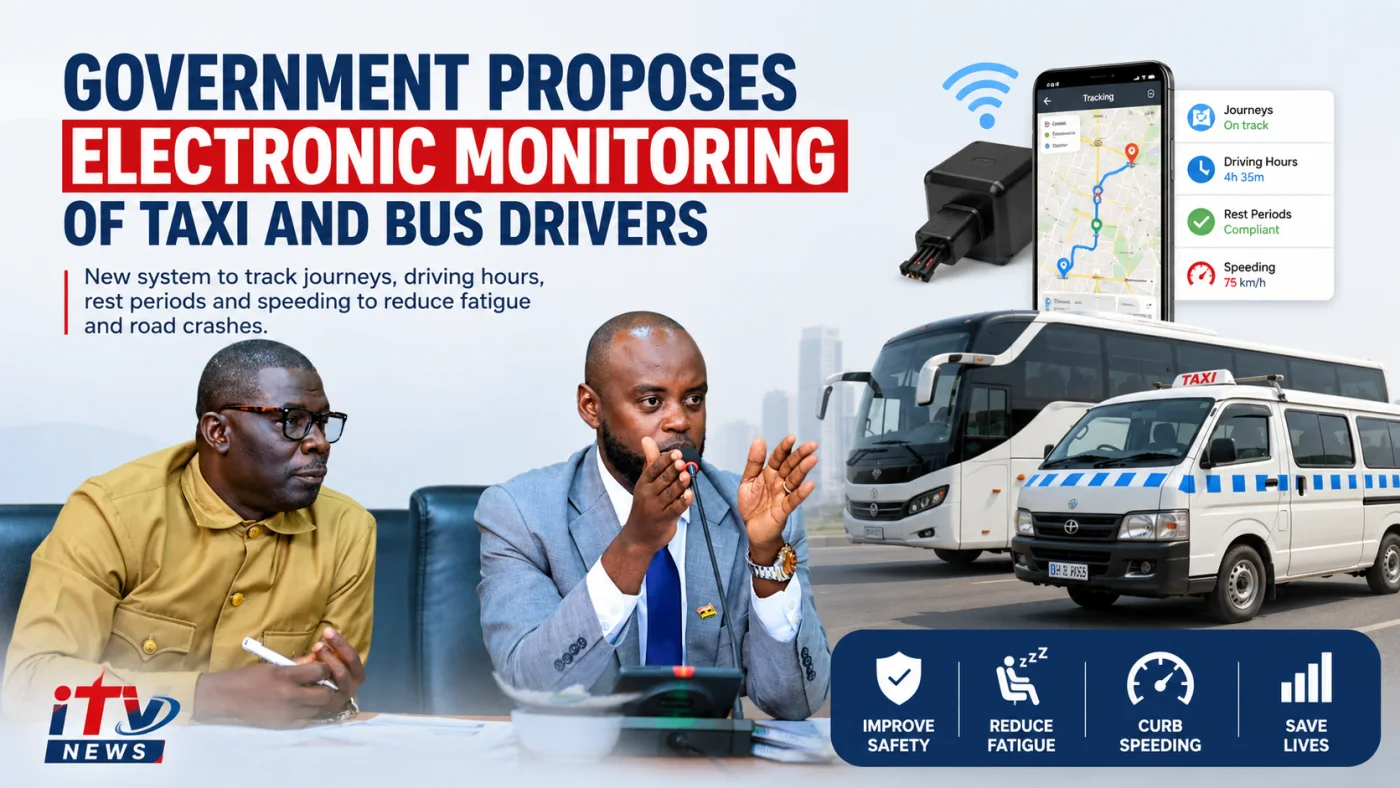
The Ministry of Works and Transport has proposed an electronic clocking-in system for taxi, bus and other public-service vehicle drivers as part of measures intended to reduce fatigue, speeding and fatal road crashes in Uganda.
The proposed system would record drivers’ journeys at designated points and enable transport authorities to monitor how long they have been driving, the rest periods taken within 24 hours and possible speeding.
Ministry officials presented the proposal to Parliament’s Committee on Physical Infrastructure during a meeting held on Monday, 20 July 2026.
The government has not yet announced when the system would be introduced, where the designated clocking points would be located or what equipment would be installed in public-service vehicles.
Driver Fatigue Under Scrutiny
Commissioner for Transport Regulation and Safety Winston Katushabe told the committee that fatigue had emerged as one of the road-safety challenges requiring greater attention.
Under the proposed arrangement, transport authorities would be able to establish how many hours a driver had worked and rested within a given period.
This could help prevent drivers from operating buses and taxis for excessive periods without adequate rest, particularly on long-distance and overnight journeys.
Fatigue can reduce concentration, delay reaction time and impair a driver’s ability to judge speed, distance and changing road conditions.
The proposed system would also help authorities establish whether a driver had exceeded permitted working hours or continued operating without taking the required break.
Proposal Follows Series of Fatal Crashes
The electronic monitoring proposal follows several deadly road crashes recorded in Uganda during July.
These included a bus crash in Omoro District that claimed dozens of lives, the King David Junior School bus tragedy along the Kapchorwa–Mbale Road and a collision involving a passenger bus and a train in Mukono.
The latest Uganda Police update placed the death toll from the Kapchorwa crash at 24 people, including the bus driver.
Investigations into the separate crashes have raised concerns about speeding, driver judgement, vehicle condition, licensing, road design and enforcement of existing transport regulations.
The ministry cautioned that the circumstances of every crash must be established through investigation rather than relying on assumptions about the driver, vehicle or road.
Unlicensed Vehicles and Drivers Identified
Katushabe said investigations into recent crashes had revealed widespread non-compliance with transport requirements.
The problems identified included buses operating without the required licences, drivers lacking proper accreditation, mechanical defects and weak enforcement of transport regulations.
The ministry is consequently considering stronger digital verification systems that would help enforcement officers identify vehicles operating without valid licences and drivers who are not authorised to operate them.
Such a system could allow traffic officers to verify licensing and driver information electronically instead of relying only on physical documents that may be expired, altered or difficult to confirm immediately.
However, the effectiveness of the proposed measures will depend on reliable records, functioning equipment, protection of personal information and consistent enforcement across the country.
Stricter Medical Examinations Proposed
The ministry also intends to strengthen medical examinations for public-transport drivers.
Members of the committee questioned whether existing examinations adequately assess eyesight, colour recognition and other medical conditions that may affect safe driving.
Kole North County Member of Parliament Samuel Opio Acuti asked how unlicensed buses were able to travel long distances without being detected by enforcement officers.
He also questioned whether drivers were undergoing sufficiently thorough medical assessments before being authorised to carry passengers.
Regular medical examinations could help identify conditions affecting vision, concentration, movement or other abilities required for the safe operation of public-service vehicles.
The ministry has not yet published the proposed medical standards, frequency of examinations or institutions that would be authorised to conduct them.
Automated Driver Testing to Be Upgraded
The government also plans to upgrade automated driver-testing equipment as part of the wider road-safety reforms.
Driver testing is intended to establish whether an applicant understands traffic laws and can safely control a vehicle under different road conditions.
Improved testing equipment could reduce reliance on subjective assessment and strengthen the verification of practical driving competence.
The reforms would need to ensure that applicants are assessed according to the class and size of vehicle they intend to operate.
Driving a large passenger bus requires additional judgement, manoeuvring ability and responsibility beyond that needed for a smaller private vehicle.
School Buses Could Face Common Standards
The ministry is also considering the standardisation of school buses following the fatal Kapchorwa crash.
Common standards could cover vehicle construction, passenger capacity, emergency exits, inspection, insurance, driver qualifications and safety equipment.
The Ministry of Education and Sports suspended school trips and educational excursions after the Kapchorwa tragedy while the government reviews safety requirements.
Any new standards for school transport would need to establish who is responsible for inspecting vehicles and confirming that drivers are qualified and adequately rested before carrying learners.
Transport Owners Urged to Accept Responsibility
Bukanga North County Member of Parliament Nathan Byanyima said owners of transport companies must accept responsibility for failures within the public-transport industry.
Byanyima urged the Ministry of Works and Transport to resume regular engagement with bus operators and other transport providers.
Vehicle owners are responsible for maintaining their fleets, employing qualified drivers and ensuring that staff are not placed under schedules that encourage speeding or driving while fatigued.
Driver monitoring may have limited effect where transport companies continue assigning unrealistic journey times or permit drivers to work excessive hours.
The proposed system would therefore need to hold both individual drivers and the companies employing them accountable.
Road Safety Audits to Continue
The ministry said road-safety audits would continue to identify dangerous sections requiring improvements in signage, markings, barriers, drainage or road design.
This acknowledges that preventing crashes cannot depend on monitoring drivers alone.
Unsafe road design, poor visibility, damaged surfaces, inadequate warning signs and narrow sections may increase risk even where a vehicle is properly licensed and the driver is qualified.
Crash investigations should therefore examine the conduct of road users alongside the condition and design of the road.
National Road Safety Plan Under Review
The government is reviewing its five-year National Road Safety Action Plan as it considers the new monitoring and enforcement measures.
The review is expected to examine driver regulation, vehicle condition, enforcement capacity, road infrastructure and the systems used to collect and analyse crash information.
Uganda has existing traffic and licensing laws, but continued fatal crashes have raised questions about the consistency of enforcement and the ability of authorities to detect violations before they result in tragedy.
An electronic clocking-in system could strengthen oversight by creating a record of journeys, working hours and rest periods.
Its success will, however, depend on whether it is implemented nationally, protected against manipulation and connected to meaningful penalties for drivers and vehicle owners who violate safety requirements.
Until detailed regulations and an implementation timetable are published, the electronic monitoring system remains a government proposal rather than an operational requirement for Uganda’s taxi and bus drivers.