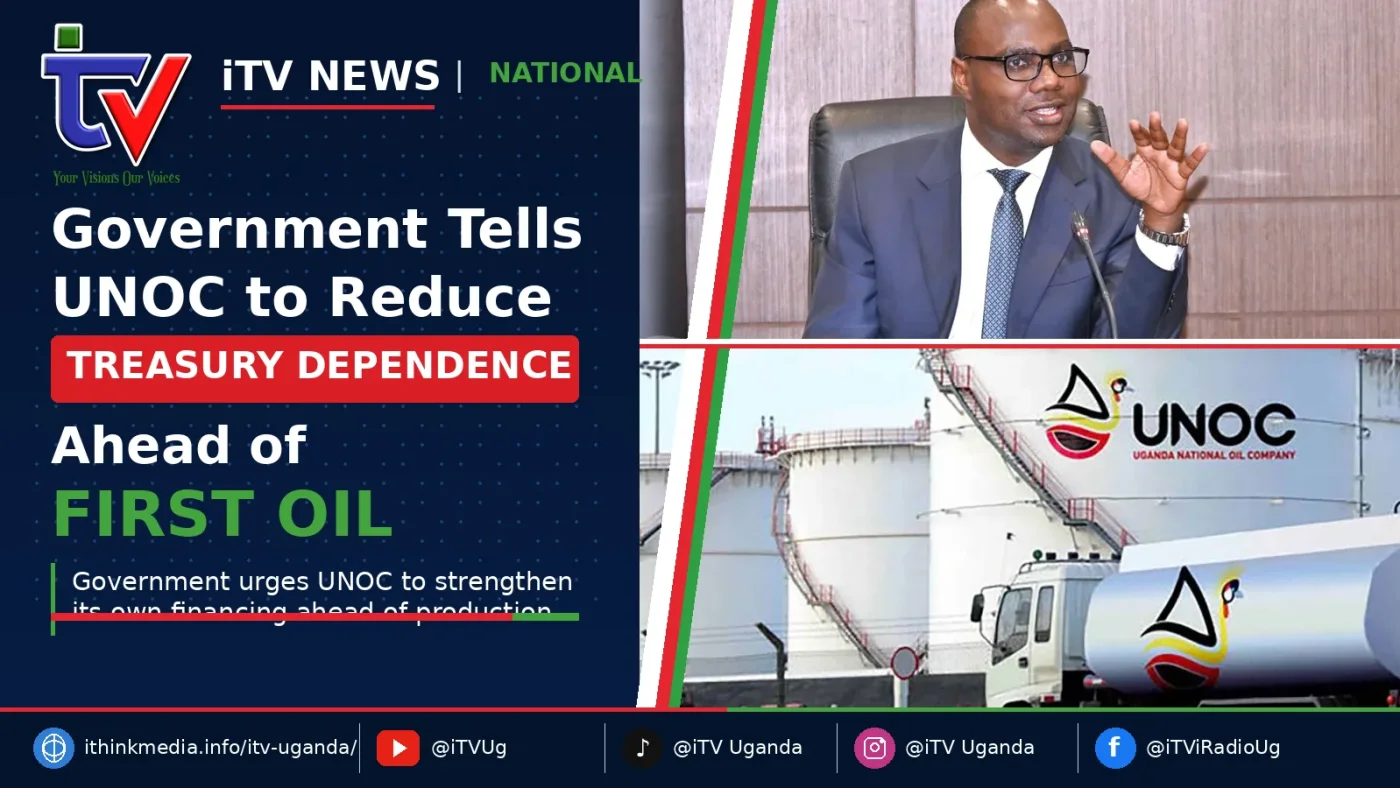
KAMPALA, Uganda — Government has directed the Uganda National Oil Company to develop new and sustainable sources of financing as the state-owned company faces growing investment obligations while Uganda's major petroleum projects move closer to production.
Finance Minister Henry Musasizi challenged UNOC to strengthen its commercial operations and develop alternative financing mechanisms capable of supporting its expanding responsibilities while reducing dependence on direct government funding.
The directive comes at a crucial stage for Uganda's petroleum programme. By the end of June 2026, the East African Crude Oil Pipeline had reached 89.4 percent completion, the Kingfisher Development Area stood at 79.36 percent and the Tilenga project was 74.2 percent complete.
At the same time, UNOC expects approximately US$72 million in cash-call obligations associated with its participation in joint petroleum investments, placing renewed attention on how Uganda will finance the state's commercial interests as the sector moves towards first oil.
Government wants less dependence on direct funding
Musasizi made the financing call during an engagement with the UNOC Board and management led by Board Chairman Mathias Katamba and Chief Executive Officer Proscovia Nabbanja.
The meeting reviewed progress on petroleum projects, fuel supply operations, financing requirements and UNOC's longer-term commercial direction.
UNOC is wholly owned by the Government of Uganda and serves as the state's commercial investment arm in the petroleum sector. Its obligations extend across oil production, the crude oil pipeline, petroleum imports, storage infrastructure, refinery development and other strategic investments.
As those responsibilities expand, government wants the company to become increasingly capable of generating and mobilising financing through its own commercial activities rather than relying primarily on allocations from the national budget.
US$72 million in cash calls ahead
One of the immediate pressures facing UNOC is approximately US$72 million in expected cash-call obligations.
Cash calls are payments that joint-venture partners are required to make towards agreed project expenditure. For UNOC, they represent Uganda's financial contribution to petroleum investments in which the national oil company holds an interest.
The company is engaging the Ministry of Finance over how those obligations will be financed as project development advances.
The issue is important because failure to meet agreed financial commitments could affect the state's participation in joint ventures, while repeatedly meeting those commitments directly from the Treasury creates competition with other national budget priorities.
EACOP reaches 89.4 percent completion
UNOC reported that the East African Crude Oil Pipeline had reached 89.4 percent completion by the end of June.
The pipeline is being developed to transport crude oil from Uganda's Albertine region through Tanzania to the coast for export to international markets.
Kingfisher, operated by CNOOC Uganda, had reached 79.36 percent completion, while the Tilenga project, operated by TotalEnergies, stood at 74.2 percent.
The figures show substantial physical progress across the projects but also illustrate why financing requirements remain significant before production and crude exports begin generating the revenues anticipated from Uganda's petroleum resources.
UNOC grows petroleum-import business
Government's demand for greater financial independence comes as UNOC reports stronger performance from its petroleum-import operations.
The company said the volume of petroleum products handled under its sole-importation arrangement increased by 39 percent, while gross margins rose from Shs387 billion in the 2024/25 financial year to Shs540 billion in 2025/26.
UNOC has also continued supplying oil marketing companies despite international geopolitical tensions and disruptions affecting petroleum markets.
The improved commercial performance could provide UNOC with a stronger foundation for developing financing models that allow more of its investment requirements to be supported from internally generated resources and commercial borrowing.
US$2 billion Vitol financing facility
UNOC is already using external financing as part of its petroleum operations.
The company provided government with an update on a US$2 billion financing facility from Vitol Bahrain E.C. signed on 19 December 2025.
Of US$800 million earmarked for other infrastructure projects under the arrangement, US$150 million had been disbursed after the required conditions were met.
UNOC said US$144.3 million of that amount was converted into approximately Shs536 billion and transferred to the Ministry of Finance on 17 June.
The facility illustrates the scale of financing arrangements increasingly surrounding Uganda's petroleum sector as UNOC moves from primarily receiving government capital towards operating as a larger commercial energy company.
Major storage investments also underway
The national oil company is simultaneously pursuing significant petroleum-storage infrastructure.
A 320-million-litre Kampala Storage Terminal is planned on approximately 300 acres at Namwabula in Mpigi District. Engineering, procurement and construction contracts have already been signed, with groundbreaking expected during August.
UNOC is also in the final stages of acquiring a 110-million-litre petroleum storage terminal at Mombasa Port in Kenya.
The transaction is expected to be completed by the end of August, subject to regulatory clearance from the COMESA Competition and Consumer Commission.
Government expects the facilities to strengthen Uganda's fuel-storage capacity, improve security of supply and reduce vulnerabilities associated with dependence on external petroleum infrastructure.
Refinery financing challenge still ahead
Beyond the upstream developments and pipeline, Uganda is also pursuing a planned 60,000-barrel-per-day crude oil refinery.
Front-End Engineering and Design studies are underway, while a tentative Final Investment Decision is expected in February 2027.
The refinery and related infrastructure at Kabalega Industrial Park will add further financing requirements to an already capital-intensive petroleum programme.
At the industrial park, UNOC has secured Shs37.96 billion in partial funding for Phase One infrastructure and engaged the National Enterprise Corporation to begin construction of 86 kilometres of roads.
Who ultimately finances Uganda's oil stake?
The Finance Ministry's directive brings a wider public-finance question into focus as Uganda approaches petroleum production: how much of the state's participation should continue to be financed directly by taxpayers, and how much should UNOC be expected to raise through commercial operations, partnerships and borrowing?
The company must balance two objectives. It is expected to protect Uganda's strategic commercial interests in petroleum projects, but it is also increasingly being asked to operate as a financially sustainable business capable of meeting a larger share of its own obligations.
For government, reducing UNOC's dependence on direct Treasury support could free public resources for other sectors while maintaining the state's participation in the petroleum industry.
For UNOC, however, achieving that transition will require commercially viable businesses, access to affordable financing and sufficient capital to meet large joint-venture commitments on time.
As EACOP, Kingfisher and Tilenga advance towards production, the debate over Uganda's oil sector is therefore shifting from whether the projects will be built to another increasingly important question: how the country's share of the petroleum business will be financed and whether it can ultimately pay its own way.