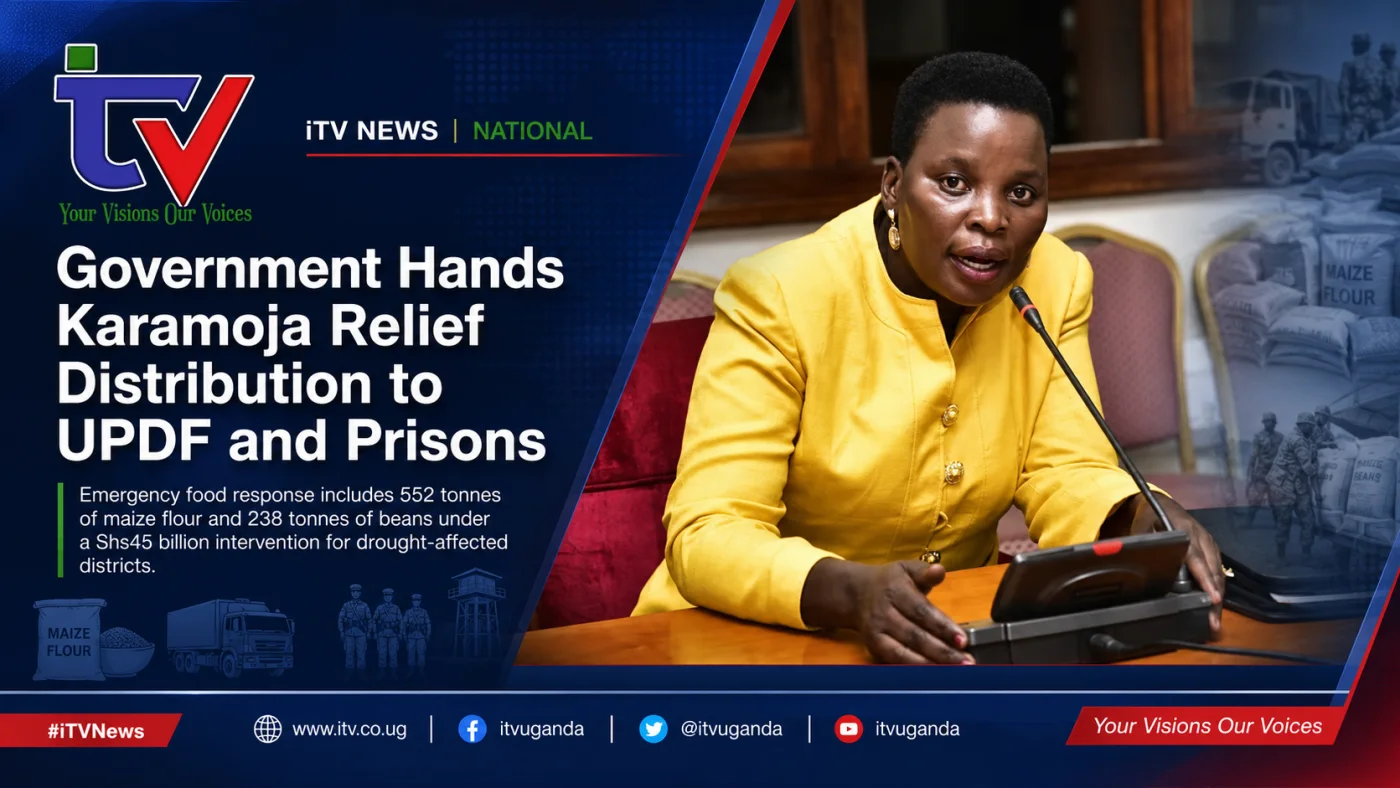
KAMPALA, UGANDA — The government has tasked the Uganda People’s Defence Forces, Uganda Prisons Service and other state agencies with supporting the distribution of emergency food relief to drought-affected communities across the Karamoja sub-region.
The revised arrangement follows a directive by President Yoweri Kaguta Museveni that the Office of the Prime Minister should reduce its dependence on contracted suppliers and use government institutions to strengthen efficiency and accountability in the delivery of relief supplies.
The intervention forms part of a Shs45 billion emergency response intended to address worsening food insecurity following a prolonged dry spell that disrupted crop production and depleted household food stocks.
An initial phase earmarked 552 tonnes of maize flour and 238 tonnes of beans for affected communities. The broader programme launched on Monday, 20 July 2026, will distribute 9,419,610 kilograms of maize flour and dry beans to 313,987 households across 480 parishes in Karamoja’s nine districts.
Government Agencies Assigned Distribution Roles
State Minister for Northern Uganda Beatrice Akori said the Office of the Prime Minister had signed a memorandum of understanding under which the National Enterprise Corporation and Uganda Prisons Service would support the supply of food.
The wider operation is being coordinated by the Office of the Prime Minister in partnership with the National Enterprise Corporation, UPDF, Uganda Prisons Service, Uganda Police Force, district local governments and other stakeholders.
The Office of the Prime Minister will retain responsibility for coordinating and monitoring the intervention, while local governments will oversee delivery to the intended households within their respective areas.
Akori said the revised distribution arrangement was intended to reduce delays, limit mishandling and ensure that relief supplies reach the intended communities.
The government has not publicly accused the previously contracted suppliers of wrongdoing. The change has instead been presented as an administrative measure intended to improve efficiency, traceability and accountability.
Nabbanja Flags Off Wider Relief Operation
Prime Minister Robinah Nabbanja officially flagged off the wider emergency food operation at the National Enterprise Corporation offices in Bugoloobi, Kampala.
“The Government stands with the people of Karamoja and will continue to mobilise the necessary resources to support their recovery,” Nabbanja said.
Minister for Relief, Disaster Preparedness and Refugees Sam Engola called upon government officials, political and religious leaders, civil society organisations and beneficiaries to support a transparent and peaceful distribution process.
The relief is intended to reach all nine districts of Karamoja, with particular attention to areas experiencing the most severe food shortages.
Hardest-Hit Districts Prioritised
The first phase of the intervention prioritised Kaabong, Kotido, Moroto, Karenga and Nabilatuk districts, which have recorded some of the most severe food-security conditions in the sub-region.
The first emergency consignment was delivered to Kaabong District on 8 July and comprised 13 tonnes of maize flour and nine tonnes of beans.
Additional supplies were subsequently arranged for other affected districts before the launch of the broader intervention covering the entire sub-region.
The government said the drought had affected seasonal crops planted during the first part of the year, leaving households with reduced harvests and rapidly declining food stocks.
Hundreds of Thousands Facing Acute Food Insecurity
An Integrated Food Security Phase Classification analysis estimated that approximately 473,000 people in Karamoja were facing Crisis-level food insecurity or worse between April and July 2026.
The total included about 41,000 people experiencing Emergency-level conditions and 432,000 people classified in Crisis.
All nine districts were classified in Phase Three, or Crisis, with the most serious conditions identified in Kaabong, Kotido, Karenga, Moroto and Nabilatuk.
The analysis attributed the deterioration to below-average food and livestock production, climatic shocks, crop pests and diseases, and high food prices.
The Office of the Prime Minister has separately estimated that approximately 600,000 vulnerable people require urgent support across the sub-region. The figures use different assessment categories and should therefore not be treated as directly interchangeable.
Accountability Central to Distribution
The involvement of security agencies and local governments is expected to strengthen logistics, transport and oversight as food is moved from government stores to communities.
Officials have been instructed to ensure that relief supplies are recorded at every stage and delivered to verified households rather than diverted, delayed or distributed through unofficial channels.
Community leaders and beneficiaries will also need clear information about the quantities allocated to each district, parish and household to support public monitoring of the exercise.
The effectiveness of the intervention will ultimately depend on whether the food reaches the most vulnerable households promptly and whether beneficiary selection is conducted fairly.
Government Plans Longer-Term Support
Permanent Secretary in the Office of the Prime Minister Alex Kakooza said the government would continue monitoring food-security conditions in Karamoja and neighbouring districts while coordinating immediate relief and longer-term resilience programmes.
The government is also engaging development partners and implementing measures under the Karamoja Regional Development Plan.
Akori said seeds had been secured through Operation Wealth Creation for distribution before the end of July to help communities prepare for the next planting period.
Food assistance can protect lives during the current emergency, but recurrent drought and food shortages will require sustained investment in water access, climate-resilient agriculture, livestock health, food storage, markets and alternative livelihoods.
The government has urged all agencies involved in the operation to ensure that emergency relief reaches the intended households transparently, safely and without unnecessary delay.