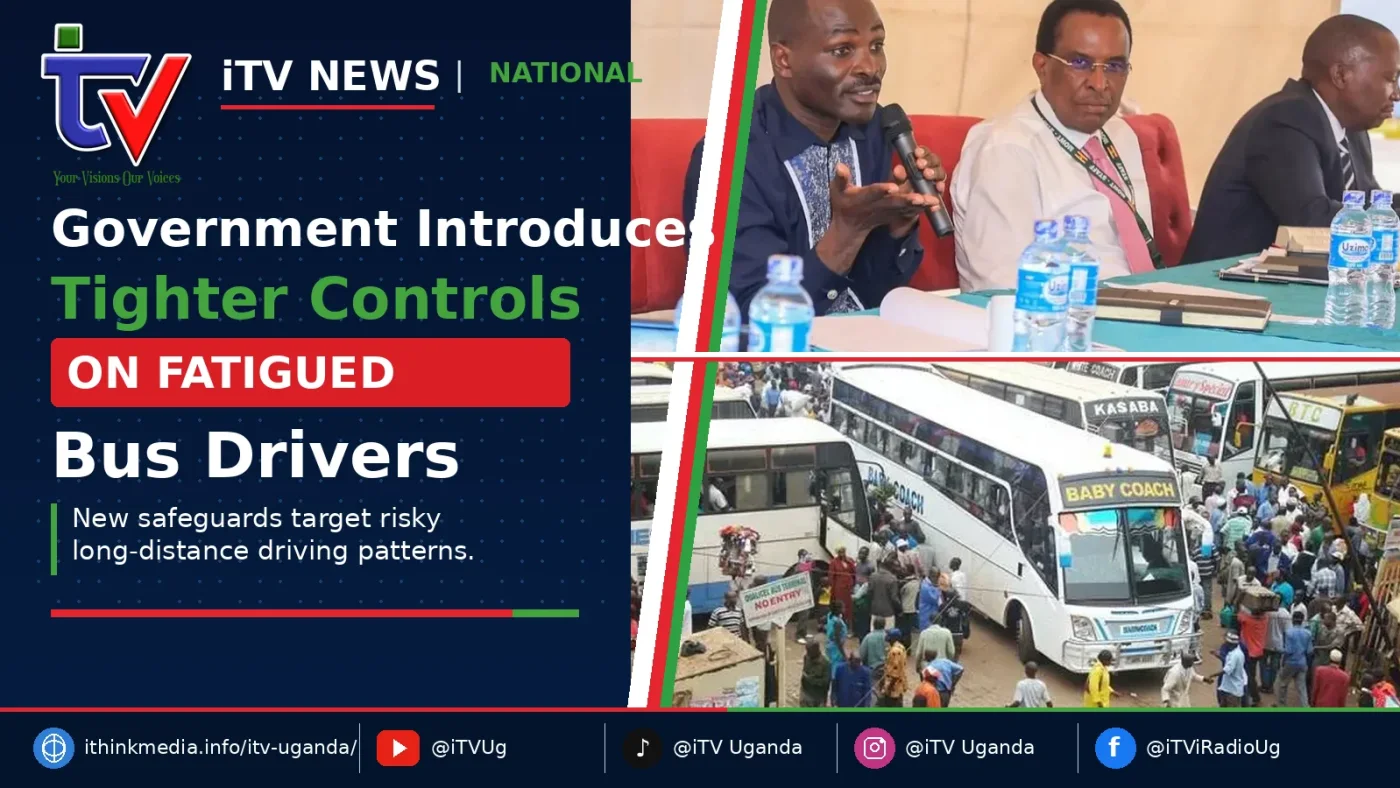
KAMPALA, Uganda — The government has introduced tighter operating rules for passenger buses in an effort to reduce driver fatigue and improve road safety following renewed concern over fatal crashes involving public-service vehicles.
Under the measures announced by the Ministry of Works and Transport, a driver operating a bus on a route longer than 300 kilometres will no longer be permitted to drive the same bus on its return journey.
Bus operators will instead be required to provide another driver for the return leg, ensuring that the person who completed the long outbound journey receives adequate rest.
For routes shorter than 300 kilometres, one driver may complete the outward journey and make one return trip. Once the driver arrives back at the original point of departure, however, that driver must stop work for the day and should not begin a third leg.
Government targets driver fatigue
Works and Transport Minister Fred Byamukama announced the measures following discussions involving bus operators, Traffic Police and other transport-sector stakeholders.
The government says fatigue has emerged as an important safety concern, particularly where drivers complete long-distance journeys and immediately begin another trip without sufficient rest.
Under the new arrangement, responsibility will also fall on bus companies to organise driver schedules in a way that prevents one individual from repeatedly operating long-distance routes without appropriate breaks.
The rules are significant for companies serving long routes connecting Kampala with destinations in northern, eastern, western and south-western Uganda, where a single journey can cover several hundred kilometres.
What changes on routes above 300 kilometres?
The most important threshold under the new measures is 300 kilometres.
If a bus travels more than 300 kilometres from its point of departure to its destination, the driver who completed that journey must not operate the return leg.
A different qualified driver must take over before the bus begins the journey back.
The requirement is designed to separate the operating schedule of the bus from that of an individual driver. A bus may be capable of continuing its scheduled service, but that does not mean the same person should remain behind the wheel after completing a long journey.
What happens on shorter routes?
Drivers operating routes below 300 kilometres will have greater flexibility, but their driving is also restricted.
One driver may make the outbound journey and return to the original departure point once.
After completing that return trip, the driver is expected to stop driving for the day rather than immediately begin another journey.
The measure is intended to prevent a situation in which drivers repeatedly shuttle between destinations for extended periods without enough time to recover.
Traffic Police expected to enforce rules
Traffic Police has been tasked with enforcing the requirements, with operators and drivers who disregard the new arrangements facing action.
The measures therefore place obligations not only on individual drivers but also on bus owners and company managers who prepare duty rosters and assign drivers to particular routes.
Operators will need to ensure that enough properly licensed and authorised drivers are available to allow long-distance services to continue without breaching the fatigue-control requirements.
Digital monitoring also being developed
The driver-rest rules come alongside a separate government plan to introduce a digital monitoring system for public-service vehicle drivers.
Earlier this month, the Ministry of Works and Transport said it was testing a system involving biometric logins that could help authorities track when drivers begin journeys, how long they remain on the road and whether they are receiving adequate rest between trips.
Transport Regulation and Safety Commissioner Winstone Katushabe said the proposed system could also help authorities identify suspicious journey times that may indicate speeding.
Under the concept, drivers would log in at terminals and their movements could be checked at designated points, allowing authorities to determine whether somebody who recently completed one long journey had immediately taken control of another vehicle.
The biometric proposal remains a separate developing measure, while the new driver-change requirements provide an immediate operational framework for bus companies.
Series of crashes puts road safety back in focus
The government measures follow a series of serious road crashes in recent weeks involving buses, school vehicles, passenger vans and heavy commercial vehicles.
The incidents have renewed scrutiny of driver behaviour, vehicle condition, speeding, route compliance and the way transport companies manage working hours for drivers.
Authorities have also intensified inspections and compliance checks targeting public-service vehicles, while operators have been urged to ensure that drivers are properly licensed and vehicles meet statutory requirements.
Driver fatigue is only one of several factors that can contribute to road crashes. Speeding, dangerous overtaking, mechanical defects, poor road conditions and other forms of unsafe driving also remain major road-safety concerns.
What passengers should expect
For passengers, the rules could mean seeing drivers changed at destinations before long-distance buses begin their return journeys.
A change of driver should therefore not necessarily be interpreted as a delay or staffing problem. On routes exceeding 300 kilometres, it is now part of the government's approach to ensuring that the person behind the wheel has not already completed an extended journey.
The effectiveness of the measures will ultimately depend on compliance by operators and consistent enforcement by transport authorities and Traffic Police.
With thousands of Ugandans relying on long-distance buses every day, the latest intervention places greater responsibility on transport companies to treat driver rest as a passenger-safety requirement rather than simply an internal staffing decision.