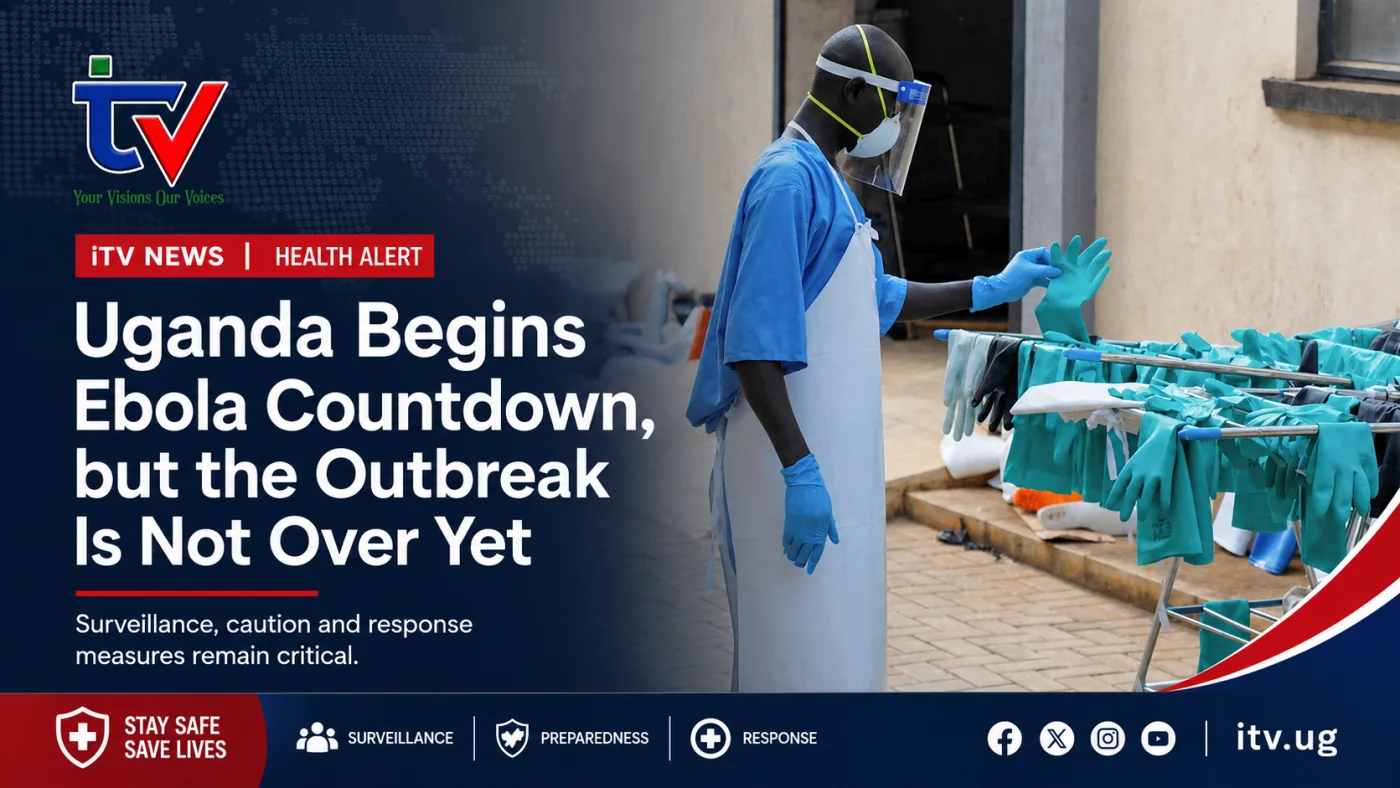
Uganda has begun the internationally required 42-day countdown towards declaring its Ebola outbreak over after the last confirmed patient recovered and was discharged from treatment.
The patient left the Mulago National Referral Isolation Centre on 16 July 2026 after testing negative for the virus twice, marking an important milestone in the country’s response.
Health authorities have, however, warned that Uganda has not yet been declared free of Ebola. Surveillance, laboratory testing, investigation of alerts and readiness at border points must continue throughout the countdown.
No new confirmed Ebola case has been reported in Uganda since 21 June, according to the latest World Health Organisation update reviewed by the iTV Uganda Newsroom.
Why the countdown lasts 42 days
The 42-day period represents two complete incubation cycles of Ebola. A person infected with the virus can take between two and 21 days to develop symptoms.
Waiting for twice the maximum incubation period gives health authorities time to determine whether any infection was missed and whether transmission has stopped.
If Uganda completes the full period without detecting another confirmed case, the Ministry of Health and the World Health Organisation may declare the outbreak over in the country.
If another case linked to the ongoing outbreak is confirmed during the countdown, the period will stop and restart from day zero after the new transmission chain has been controlled.
A restart would not necessarily indicate failure by Uganda’s health authorities. It would reflect the difficulty of controlling an outbreak that remains active across an international border and involves regular movement between neighbouring communities.
Uganda recorded 20 confirmed cases
Uganda declared the outbreak on 15 May 2026 after infections linked to the Democratic Republic of the Congo were detected.
By mid-July, the country had recorded 20 laboratory-confirmed cases, including two deaths. Health authorities also recorded one probable case that resulted in death.
Fifteen of the confirmed infections were imported from the Democratic Republic of the Congo, while five were secondary cases among contacts and health workers connected to imported cases.
All the confirmed cases were reported in Kampala. The World Health Organisation said no community transmission had been established in Uganda.
Eighteen people with confirmed infections recovered, including the final patient discharged on 16 July.
Four health workers were among those infected during the outbreak, highlighting the risks faced by medical personnel when treating patients whose early symptoms can resemble malaria, typhoid and other common illnesses.
Surveillance strengthened across the country
The Ministry of Health, working with the World Health Organisation and other partners, implemented contact tracing, laboratory testing, isolation and treatment, infection-prevention measures and public awareness activities.
WHO reported that all 836 contacts identified during Uganda’s response had been followed up by 16 July.
Surveillance systems were strengthened in 36 districts considered at high risk and at 38 points of entry, including border crossings and other transport routes.
Health workers received training, medical equipment and protective supplies to improve the identification, isolation and management of suspected cases.
WHO also deployed about 70 technical experts to support laboratory services, logistics, surveillance, contact tracing, infection prevention and engagement with affected communities.
The Ministry of Health has launched a six-month plan intended to maintain readiness, reduce the risk of renewed transmission and ensure that imported cases can be detected and contained quickly.
Outbreak remains active in DR Congo
Uganda’s greatest continuing risk comes from the ongoing outbreak in the Democratic Republic of the Congo.
As of 15 July, the Democratic Republic of the Congo had reported 2,124 confirmed cases and 828 deaths across five provinces, according to WHO.
The outbreak remained active in 38 health zones, with Ituri Province accounting for most of the confirmed infections.
Regular movement for trade, health care, family visits and other activities along the eastern DR Congo–western Uganda corridor continues to create a risk of additional imported cases.
WHO continues to assess the risk in Uganda as high because of the demonstrated cross-border spread and continuing epidemiological links with affected communities in the Democratic Republic of the Congo.
Ugandan health authorities have therefore emphasised that the beginning of the countdown should not lead to complacency, particularly in border districts, health facilities and communities receiving travellers from affected areas.
What people should watch for
The current outbreak is caused by the Bundibugyo virus, one of the viruses responsible for Ebola disease.
Early symptoms may include sudden fever, severe tiredness, muscle pain, headache and sore throat. These may later be followed by vomiting, diarrhoea, abdominal pain, rash and impaired liver or kidney function.
Some patients may develop internal or external bleeding, although bleeding does not occur in every Ebola case and is often a later symptom.
The early signs can resemble malaria and other illnesses common in Uganda. A person cannot be confirmed as having Ebola based on symptoms alone; laboratory testing is required.
Anyone who develops compatible symptoms after contact with a suspected patient, a person who died from an unexplained illness or someone travelling from an affected area should avoid close contact with others and seek guidance from health authorities immediately.
The Ministry of Health can be reached through its toll-free line on 0800 100 066. Members of the public may also send an alert by SMS to 6767 or through U-Report on 8500.
How Ebola spreads
Ebola is mainly transmitted through direct contact with the blood or other body fluids of an infected person who is showing symptoms or has died from the disease.
Transmission can also occur through contact with materials contaminated by infectious fluids, including clothing, bedding, medical equipment and surfaces.
People infected with Ebola are generally not infectious before their symptoms begin.
Unsafe care and burial practices can increase transmission when people come into direct contact with the body or fluids of someone who has died from the disease.
Families and communities should immediately report suspected deaths and allow trained health personnel to guide safe and dignified burial arrangements.
No approved vaccine for Bundibugyo virus
Vaccines and specialised antibody treatments used against some other Ebola viruses have not yet been approved specifically for Bundibugyo virus disease.
Clinical care therefore focuses on early detection, isolation and supportive treatment, including careful management of fluids, oxygen and complications.
Early recognition and prompt medical care can improve a patient’s chances of recovery and help prevent the infection from spreading to relatives, health workers and other community members.
WHO technical groups are assessing potential vaccines and treatments for use against the Bundibugyo virus.
Vigilance without panic or stigma
The countdown is encouraging evidence that Uganda has interrupted the known chains of transmission. It should not become a source of panic, discrimination or hostility towards people travelling from the Democratic Republic of the Congo.
Suspected patients, survivors, health workers and affected families should be treated with dignity. Stigma can discourage people from reporting symptoms or cooperating with contact-tracing teams, making outbreak control more difficult.
WHO has advised against imposing general travel or trade restrictions on Uganda or the Democratic Republic of the Congo based on the available public-health information.
The priority is targeted surveillance, rapid investigation of alerts, cross-border cooperation and accurate communication from trusted health authorities.
The outbreak is not over yet
Discharging the last patient is an important achievement for Uganda’s health workers, laboratory teams, contact tracers, communities and partners.
It means there is currently no confirmed Ebola patient receiving treatment in Uganda and no known active transmission chain within the country.
It does not mean the response has ended.
For the remainder of the countdown, health teams must continue investigating unusual illnesses and deaths, testing suspected cases, protecting frontline workers and monitoring entry points.
Uganda’s outbreak can be officially declared over only after the full 42 days pass without another confirmed case.
Until then, the appropriate national message is one of guarded progress: the known transmission chains have been interrupted, but continued vigilance is essential while the wider cross-border outbreak remains active.