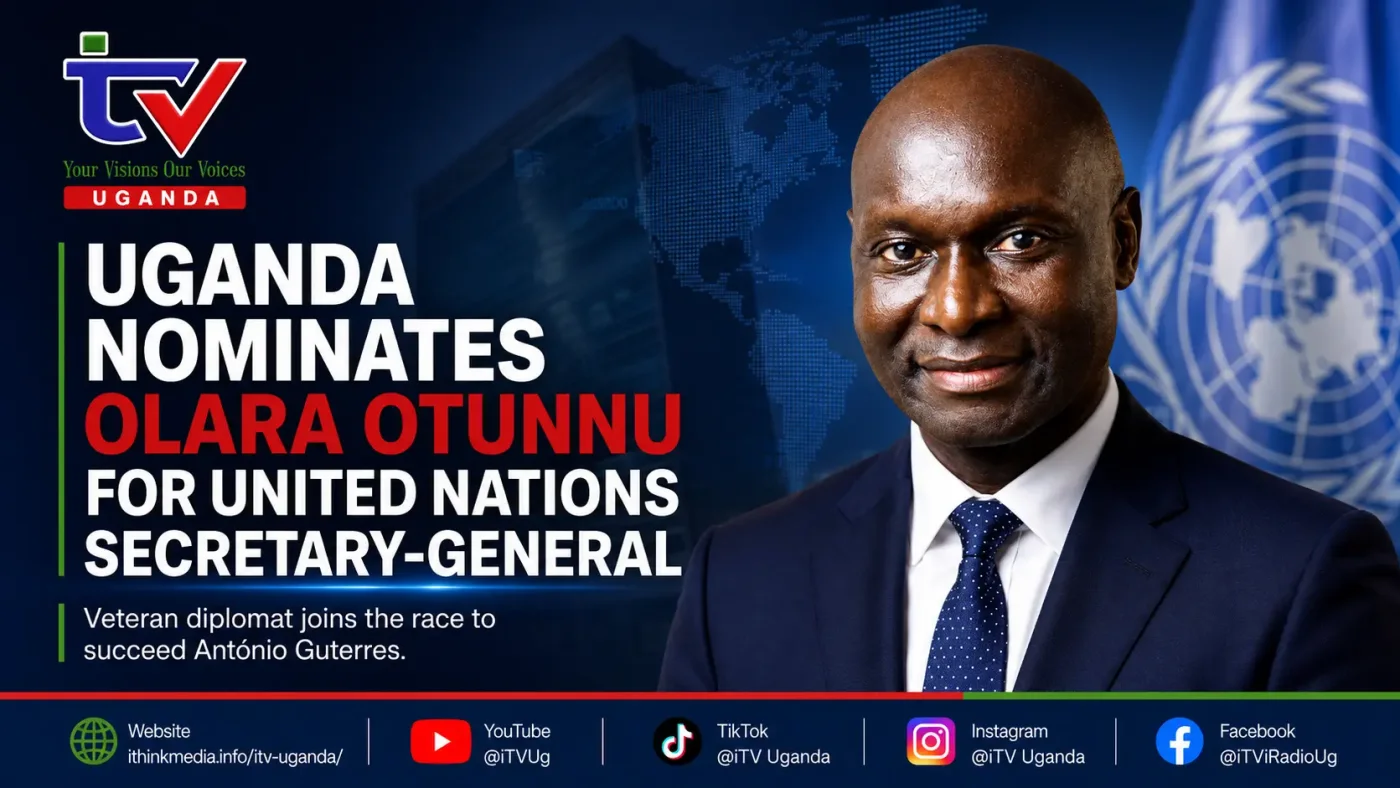
KAMPALA, UGANDA — The Government of Uganda has formally nominated veteran diplomat Ambassador Olara Otunnu for the position of United Nations Secretary-General.
The Ministry of Foreign Affairs announced the candidature on Sunday, 26 July 2026, describing Otunnu as a distinguished Ugandan statesman and international civil servant with more than four decades of experience in diplomacy, government, academia, peacebuilding and civil society.
Uganda submitted the nomination through a letter addressed to the presidents of the United Nations General Assembly and Security Council on Friday, 24 July.
Otunnu becomes the seventh declared candidate seeking to succeed António Guterres, whose second five-year term as UN Secretary-General ends on 31 December 2026.
The successful candidate is expected to take office on 1 January 2027.
Uganda Calls for International Support
In its announcement, the Ministry of Foreign Affairs called upon United Nations member states to support Otunnu’s candidature.
The government said his experience across the UN Secretariat, Security Council, national government, academia and community peacebuilding placed him in a strong position to lead the organisation at a difficult moment in international affairs.
The statement was signed by Ministry of Foreign Affairs Permanent Secretary Vincent Waiswa Bagiire.
Uganda’s nomination places Otunnu in a competitive international contest that will ultimately require the support of the UN Security Council and the wider General Assembly.
Long Record Within the United Nations
Otunnu previously served as Uganda’s Ambassador and Permanent Representative to the United Nations from 1980 to 1985.
During that period, he served as President of the UN Security Council in December 1981, when the Council was engaged in the difficult process of selecting a successor to then Secretary-General Kurt Waldheim.
Otunnu helped introduce a straw-balloting procedure through which Security Council members could indicate whether they encouraged or discouraged particular candidates.
The approach became associated with his name as the “Otunnu Formula” and has continued to influence the confidential straw polls used in subsequent UN Secretary-General selection processes.
The 1981 process eventually led to the selection of Peruvian diplomat Javier Pérez de Cuéllar as Secretary-General.
Otunnu later returned to senior UN service as Under-Secretary-General and the first Special Representative of the Secretary-General for Children and Armed Conflict.
He served in that role from 1997 to 2005, helping to place the protection of children affected by war more firmly on the agenda of the UN Security Council.
His work contributed to the development of international systems for documenting and responding to grave violations against children during armed conflict.
Service in Uganda and International Institutions
At the national level, Otunnu served as Uganda’s Minister of Foreign Affairs between 1985 and 1986.
He was also a member of the Uganda National Consultative Council during the transitional period following the fall of former President Idi Amin.
From 1990 to 1998, Otunnu served as President of the International Peace Academy, now known as the International Peace Institute.
He has also held academic positions at institutions including Albany Law School, the American University of Paris and the French Institute of International Relations.
Otunnu later became president of the Uganda People’s Congress and contested Uganda’s 2011 presidential election as the party’s candidate.
In recent years, he has participated in Roco Paco, a community-rooted peacebuilding and reconciliation initiative in northern Uganda, alongside Chief Justice Emeritus Alfonse Chigamoy Owiny-Dollo.
Otunnu Outlines Priorities for the United Nations
In the vision statement accompanying his candidature, Otunnu placed emphasis on institutional reform within the United Nations and restoring the organisation’s effectiveness in responding to major global conflicts.
He said immediate attention would be required to strengthen international conflict resolution and improve the UN’s ability to act in situations where political divisions have weakened collective action.
Otunnu also proposed creating a coordinating body to oversee the UN system’s work on artificial intelligence.
His stated priorities include action on climate change while ensuring that environmental policies do not unnecessarily undermine development and economic transformation, particularly in poorer countries.
The next Secretary-General will inherit an organisation facing financial pressure, demands for administrative reform and continuing divisions among major powers over conflicts and international security.
Seven Candidates in the Race
Otunnu joins six other candidates who had already entered the contest.
They include International Atomic Energy Agency Director-General Rafael Grossi of Argentina; former Chilean President Michelle Bachelet; UN Trade and Development Secretary-General Rebeca Grynspan of Costa Rica; former UN General Assembly President María Fernanda Espinosa of Ecuador; former Guyanese Foreign Minister Carolyn Rodrigues-Birkett; and former Senegalese President Macky Sall.
Additional candidates may still be nominated as the selection process continues.
There is no formal rule requiring the position to rotate between regions. However, some diplomats and member states have argued that Latin America and the Caribbean should provide the next Secretary-General.
There is also a strong international campaign for the United Nations to appoint a woman for the first time in its history.
How the UN Secretary-General Is Selected
The UN Secretary-General is appointed by the 193-member General Assembly following a recommendation from the 15-member Security Council.
Security Council members normally conduct confidential straw polls to assess the level of support for each candidate and gradually narrow the field.
A successful candidate must obtain sufficient support within the Council while avoiding a veto from any of its five permanent members: China, France, Russia, the United Kingdom and the United States.
Once the Security Council agrees on a candidate, it sends a formal recommendation to the General Assembly for appointment.
The Security Council is expected to intensify its private discussions and straw polls during the second half of 2026, with the final appointment expected before Guterres completes his term.
A Ugandan Bid for Global Leadership
Otunnu’s nomination gives Uganda a place in one of the world’s most closely watched diplomatic selection processes.
His candidature is expected to draw attention to his previous UN leadership, involvement in the protection of children affected by war and experience in international peace and security.
It will also require sustained diplomatic engagement by Uganda to build support across regional groups and among the permanent members of the Security Council.
The government has said Otunnu’s experience and record of service make him well suited to lead the United Nations at a time of global conflict, institutional pressure and demands for reform.
The final decision will rest with UN member states through the Security Council and General Assembly selection process.