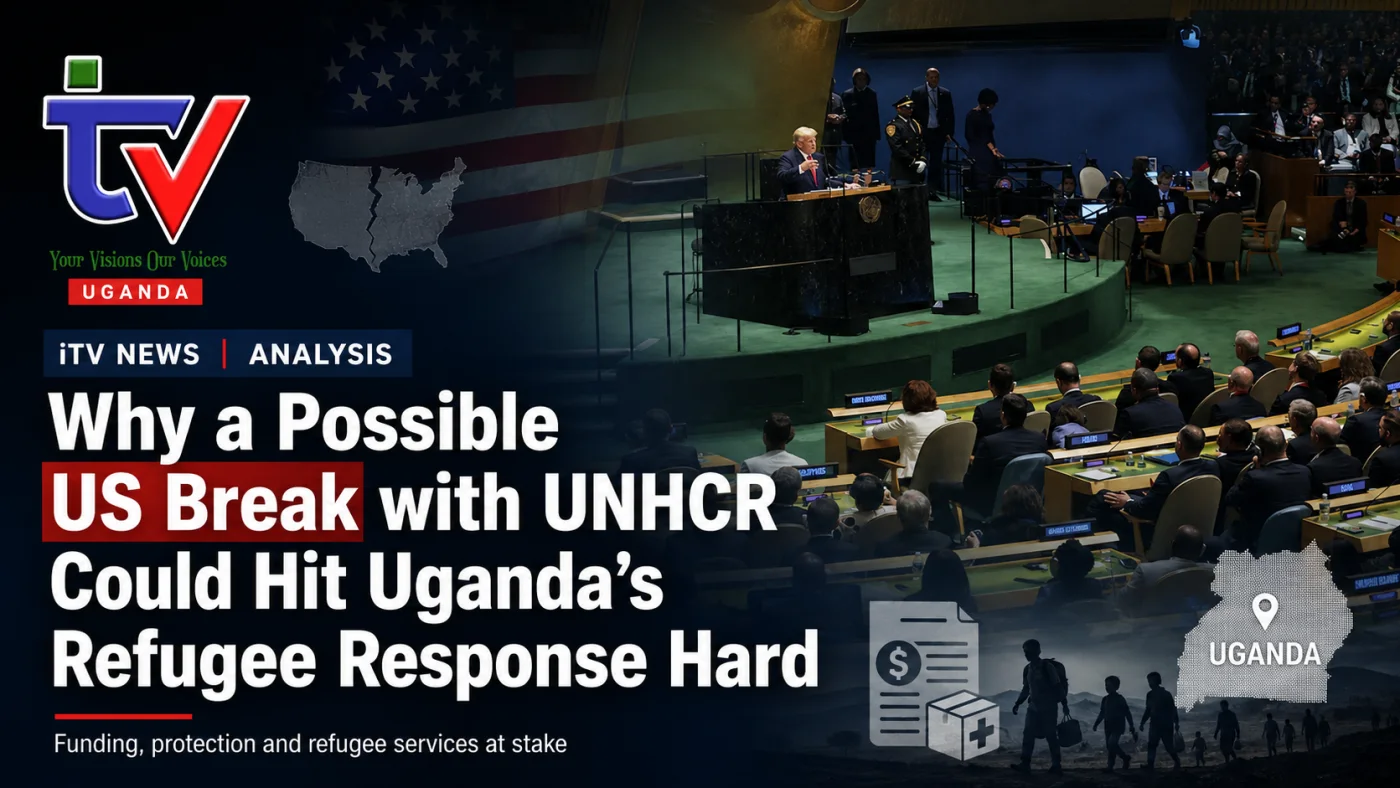
A diplomatic disagreement unfolding thousands of kilometres from Uganda could carry serious consequences for refugee families, host communities and humanitarian services across the country.
The United States has reportedly considered reducing or ending its engagement with the United Nations High Commissioner for Refugees, commonly known as UNHCR, at a time when the agency is already facing one of the deepest financial crises in its history.
No withdrawal has been formally announced. The United States Department of State said on 20 July 2026 that there had been no change in Washington’s engagement with UNHCR and that the government would continue reviewing its participation in international organisations.
However, the fact that such a move has been under consideration matters greatly to Uganda, which hosts more refugees than any other African country and depends heavily on international support to sustain protection, health, education, shelter and other essential services.
Washington has not yet withdrawn
Reuters reported that diplomats, humanitarian officials and a congressional source had been working to discourage the administration of US President Donald Trump from cutting ties with UNHCR.
The reported disagreement followed the appointment of American diplomat Tressa Rae Finerty as UNHCR’s Deputy High Commissioner. She was selected over Simon Hankinson, another American candidate reportedly supported by Washington.
Sources cited by Reuters said possible measures under consideration included ending US funding to UNHCR and withdrawing from the agency’s governing Executive Committee.
The State Department did not confirm that such a decision had been made. It instead maintained that the United States would work with UNHCR where doing so served American foreign-policy interests or helped save lives.
This distinction is important. Uganda has not yet lost UNHCR support because of the reported dispute, and it would be inaccurate to claim that Washington has already abandoned the refugee agency.
The concern arises from what could follow if the United States eventually withdraws its financial and political support.
The United States has been UNHCR’s largest donor
The United States contributed approximately US$868 million to UNHCR in 2025, representing about one-quarter of all contributions received by the agency that year.
A complete withdrawal would therefore create a major gap that could not easily be filled by one government or donor.
UNHCR was already experiencing financial pressure before the latest diplomatic disagreement. Funding available to the agency fell by approximately 30 per cent in 2025 compared with the previous year, leading to thousands of job losses and reductions in operations.
The agency has warned that its funding could decline further in 2026 even as conflicts in Sudan, South Sudan, the Democratic Republic of the Congo, Ukraine and other parts of the world continue forcing people from their homes.
Any reduction in American support would affect UNHCR globally. The precise amount Uganda might lose cannot yet be calculated because some contributions are allocated directly to countries while other funds are provided flexibly and distributed according to changing humanitarian priorities.
Uganda now hosts more than two million people
Uganda was hosting 2,031,697 refugees and asylum seekers as of 30 June 2026, according to figures from the Office of the Prime Minister and UNHCR.
The total included 1,957,559 recognised refugees and 74,138 asylum seekers awaiting the determination of their claims.
More than one million are from South Sudan, while Uganda also hosts more than 661,000 refugees and asylum seekers from the Democratic Republic of the Congo. Around 95,000 Sudanese refugees have also sought safety in Uganda following the war in their country.
Many are children. More than half of the South Sudanese refugees living in Uganda are below the age of 18, while children are estimated to constitute between 50 and 55 per cent of the Congolese refugee population.
Uganda’s refugee framework allows recognised refugees to move, work, establish businesses and access public services. Refugee-hosting districts also accommodate settlements rather than closed camps, creating daily interaction between refugees and Ugandan communities.
This approach has earned Uganda international recognition, but it requires significant investment in schools, health facilities, water systems, roads, protection services, livelihoods and environmental restoration.
A response already facing a major deficit
UNHCR estimated that its Uganda operation would require approximately US$361 million in 2026.
By 30 June, it had received or been allocated about US$79.85 million, representing only 22 per cent of its requirements. This left an indicative funding gap of approximately US$281.1 million.
The United States had contributed US$9 million specifically earmarked for UNHCR’s Uganda operation by the end of June. Uganda could also benefit from flexible global contributions that UNHCR distributes across countries according to need.
The wider Uganda refugee response involves government institutions, United Nations agencies, international organisations, national organisations and refugee-led groups. The Office of the Prime Minister reported in June that the overall response faced a funding gap of about US$608.5 million.
“These steadily growing refugee numbers deeply worry us amidst dwindling global humanitarian and development funding,” Relief, Disaster Preparedness and Refugees Minister Sam Engola said.
Engola said the deficit was already contributing to food rationing and affecting the provision of health and education services.
Food assistance shows what funding cuts can mean
The decline in food assistance offers a clear example of how humanitarian funding decisions can affect families.
The World Food Programme, which manages much of the food assistance provided to refugees in Uganda, reported in March that its support had fallen from about 1.6 million refugees at the beginning of 2025 to approximately 663,000.
WFP attributed the reduction to severe funding shortages rather than to a decline in humanitarian need.
It reported that 65 per cent of refugees lacked sufficient food, more than seven in every 10 refugee households had reduced the number of meals eaten each day, and one in four households had withdrawn children from school.
These are WFP figures and relate to food assistance, not directly to UNHCR’s budget. However, they demonstrate the wider pressure facing Uganda’s humanitarian response before any additional loss of international support.
UNHCR performs different but connected responsibilities, including registration, protection, legal assistance, shelter support, emergency relief, refugee-status systems and coordination with the Government of Uganda and other humanitarian partners.
When one major part of the response is underfunded, the pressure often spreads. Families without sufficient food may struggle to keep children in school, pay for transport to health facilities or invest in livelihood activities intended to reduce their dependence on aid.
Host communities would also feel the impact
Refugee assistance does not operate separately from Ugandan communities.
Health centres, schools, roads, water points, markets and natural resources in refugee-hosting districts are frequently shared by refugees and local residents.
When international funding supports a classroom block, health worker, water system or livelihood programme, the benefit may extend to both populations. When financing is reduced, both refugees and host communities can experience longer queues, crowded classrooms, medicine shortages and greater pressure on land and water.
Districts hosting large refugee populations have repeatedly called for predictable development support because local government budgets were not designed to serve such rapidly expanding populations.
This is why the possible US–UNHCR break should not be viewed only as a diplomatic dispute between Washington and a United Nations agency. Its consequences could eventually reach communities in Adjumani, Yumbe, Isingiro, Kyegegwa, Kikuube, Kiryandongo, Lamwo, Obongi and other refugee-hosting districts.
Local organisations cannot replace major donors
Ugandan organisations, refugee-led groups, faith institutions and community volunteers often provide services where international organisations have limited reach.
They understand local languages, settlement structures and the practical concerns of families. Many support child protection, psychosocial care, livelihoods, disability inclusion, education and referrals.
Greater investment in such organisations can make the humanitarian response more locally rooted, accountable and sustainable.
However, local organisations cannot be expected to replace the financial capacity of the world’s largest humanitarian donors. Community leadership is essential, but it still requires adequate resources, technical support and functioning public services.
Localisation should therefore mean giving national and refugee-led organisations a fairer role in decision-making and funding, rather than transferring responsibilities to them without the resources needed to carry out those duties safely.
What happens next
The immediate issue to watch is whether the United States formally changes its financial or political relationship with UNHCR.
A continued relationship would not automatically resolve the agency’s financial crisis, but it would prevent the sudden loss of its historically largest donor.
A withdrawal could trigger further reductions in global programmes and force UNHCR to decide which emergencies and activities receive limited available resources.
Uganda would then need to intensify diplomatic engagement with the United States, European governments, development banks, private donors and other partners to protect essential services.
It would also need to continue integrating refugees into national and district development planning while ensuring that refugee-hosting communities receive adequate investment.
For now, the reported US–UNHCR break remains a possibility rather than a completed decision. But Uganda’s existing funding deficit means that even the possibility deserves attention.
The country has maintained an open-door policy while regional conflicts continue producing new displacement. That responsibility cannot be sustained by Uganda and host communities alone.
Whether the diplomatic disagreement is resolved or not, the broader message remains unchanged: international responsibility-sharing is essential if refugees are to live safely and if the Ugandan communities hosting them are not left to carry a global burden with diminishing support.