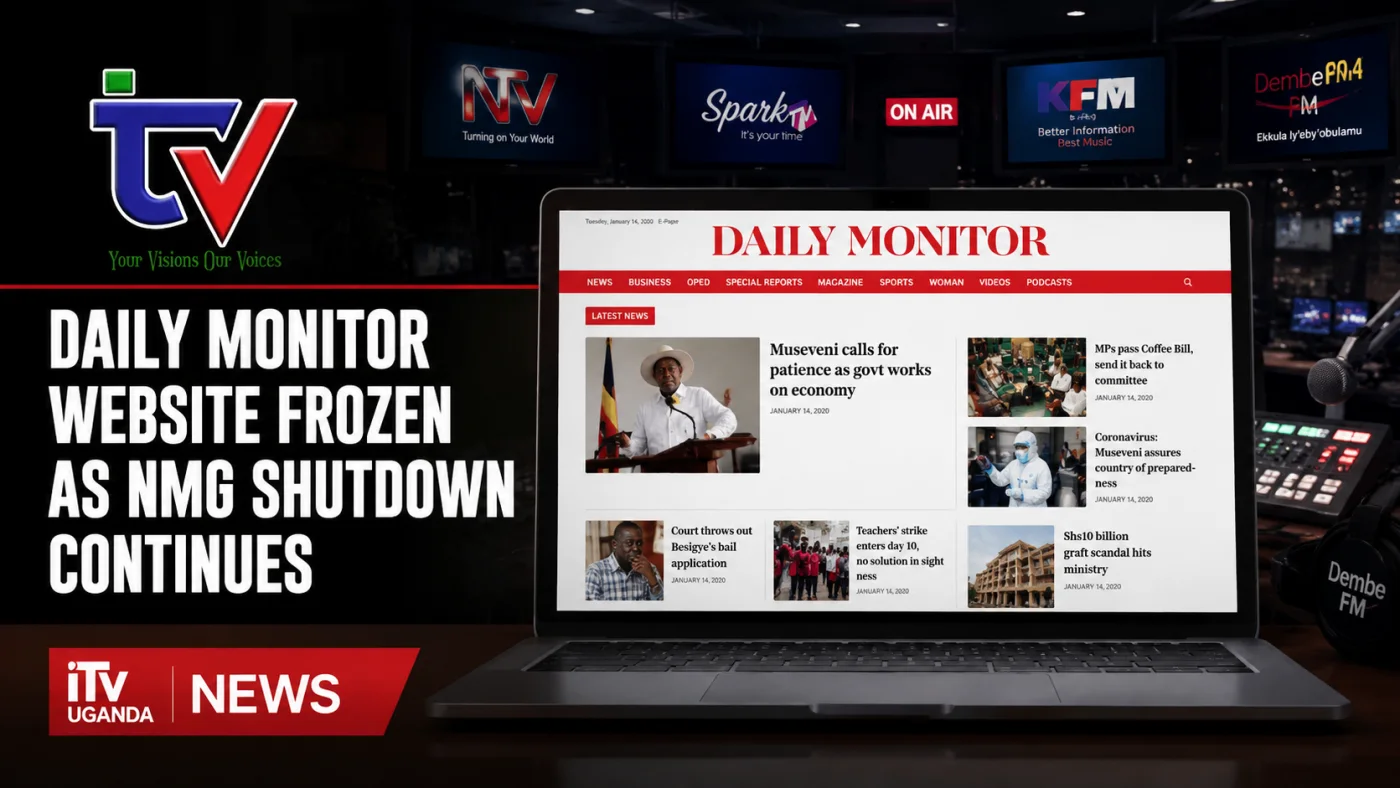
The Daily Monitor website remains accessible but appears frozen, with no fresh news visible beyond 30 June 2026, as the disruption of Nation Media Group Uganda’s operations enters its fourth week.
Checks by the iTV Uganda Newsroom on Tuesday, 21 July, found that the website displayed the current date but continued to lead with reports published three weeks earlier.
The homepage, National News section and other principal news pages remained populated by stories dated 30 June or earlier. This indicates that the website itself is not technically offline, but its regular editorial publishing appears to remain suspended.
By the time of publication, iTV Uganda had found no official announcement from NMG Uganda, the Uganda Communications Commission or the Uganda People’s Defence Forces confirming the full restoration of the company’s print, television, radio and online news operations.
How the shutdown unfolded
NMG Uganda’s operations were disrupted during the early hours of Sunday, 28 June, after military personnel were deployed at the company’s headquarters in Namuwongo and its television studios at the Kampala Serena International Conference Centre.
The deployment followed public statements by Chief of Defence Forces Gen Muhoozi Kainerugaba announcing the closure of the Daily Monitor and NTV Uganda.
NTV Uganda and Spark TV were forced off air at approximately 5:00 a.m., while the company’s radio stations, 93.3 KFM and 90.4 Dembe FM, also stopped broadcasting.
Access to the Daily Monitor offices and other NMG facilities was restricted, disrupting newspaper production and preventing many employees from reaching their workplaces.
Gen Kainerugaba said the Daily Monitor and NTV Uganda would not reopen without his permission. In one of his public statements, he wrote:
“In Uganda, I do not believe in a free press.”
No formal regulatory order outlining the alleged offences, legal basis or intended duration of the shutdown had been made public when the operation began.
Digital publishing initially continued
NMG Uganda initially announced that it would continue serving audiences through its digital platforms while its physical offices remained inaccessible.
Daily Monitor journalists briefly continued publishing stories remotely, while NTV Uganda produced limited online content, including broadcasts of its Luganda-language news bulletin, Akawungeezi, through social-media platforms.
That arrangement did not last. The Observer, citing sources within NMG Uganda, reported that company management later instructed editorial teams to stop all online publishing and digital broadcasting.
According to the report, employees were told that continued publication could jeopardise engagements intended to secure the reopening of the affected outlets.
The apparent suspension of online publishing explains why the Daily Monitor website remains publicly accessible but has not carried a normal flow of current news since 30 June.
Government points to security inquiry
Minister for ICT and National Guidance Justine Kasule Lumumba said the disruption arose from a security-led inquiry ordered by President Yoweri Museveni.
She said the inquiry involved the Uganda People’s Defence Forces, the Criminal Investigations Directorate of the Uganda Police Force, other security agencies and technical experts.
The government statement did not publicly identify the specific content or alleged conduct being investigated, nor did it provide a timetable for completing the inquiry.
NMG Uganda Managing Director Susan Nsibirwa told Reuters on 30 June that negotiations were taking place at different levels to secure the reopening of the company’s operations.
Gen Kainerugaba subsequently met representatives of Nation Media Group on 1 July to discuss the closure. The UPDF reported the meeting but did not announce that the affected outlets had been authorised to resume normal operations.
Case attracts international attention
The shutdown attracted extensive regional and international coverage, placing Uganda’s treatment of the media under renewed scrutiny.
Reuters and the Associated Press reported on the military deployment, the interruption of NMG Uganda’s operations and Gen Kainerugaba’s public statements about press freedom.
Al Jazeera also covered the closure, while Spain’s El País examined its effect on journalists and the wider media environment in Uganda.
Nation Media Group’s Kenyan and regional outlets, including NTV Kenya, Nation Africa and The EastAfrican, provided detailed reporting on the shutdown, the continued restriction of access to the company’s premises and efforts to negotiate a reopening.
Kenyan broadcaster Citizen Digital also reported on the operation and the removal of NMG Uganda’s television stations from the air.
Reporters Without Borders described the military intervention as an unprecedented escalation against Uganda’s independent media and called for the immediate reopening of all affected outlets.
The Committee to Protect Journalists, Amnesty International, the Kenya Editors Guild, the East African Press Councils, the East Africa Journalists Federation, WAN-IFRA and the World Editors Forum also condemned the shutdown or called for respect for media freedom and the safety of journalists.
United States Senate Foreign Relations Committee Chair Jim Risch called for Washington to reconsider aspects of its security relationship with Uganda following the media closures.
Not the first confrontation
The June 2026 operation is not the first time the Daily Monitor and its sister platforms have been closed or disrupted by state agencies.
In 2013, police occupied the Daily Monitor premises for more than a week after the newspaper published a letter attributed to then Gen David Sejusa concerning an alleged political succession plan known as the “Muhoozi Project”.
The operation disrupted the newspaper and its sister radio stations before the outlets were eventually permitted to resume operations.
NTV Uganda also faced government intervention shortly after its launch in 2006, when its transmission was temporarily interrupted amid disagreements involving licensing and editorial coverage.
What remains unconfirmed
It remains unclear whether all NMG Uganda employees have regained access to their workplaces, whether newspaper printing has resumed or when the company’s television and radio signals will be restored.
There has also been no publicly confirmed outcome from the negotiations involving NMG representatives, government officials and security authorities.
Without a formal announcement from NMG Uganda or the relevant authorities, claims that NTV Uganda, Spark TV, KFM, Dembe FM and the Daily Monitor have fully resumed normal operations should be treated cautiously.
The position verified by iTV Uganda is that the Daily Monitor website remains accessible but frozen on reports published at the end of June, while the complete restoration of NMG Uganda’s print, broadcast and digital operations has not been publicly confirmed.