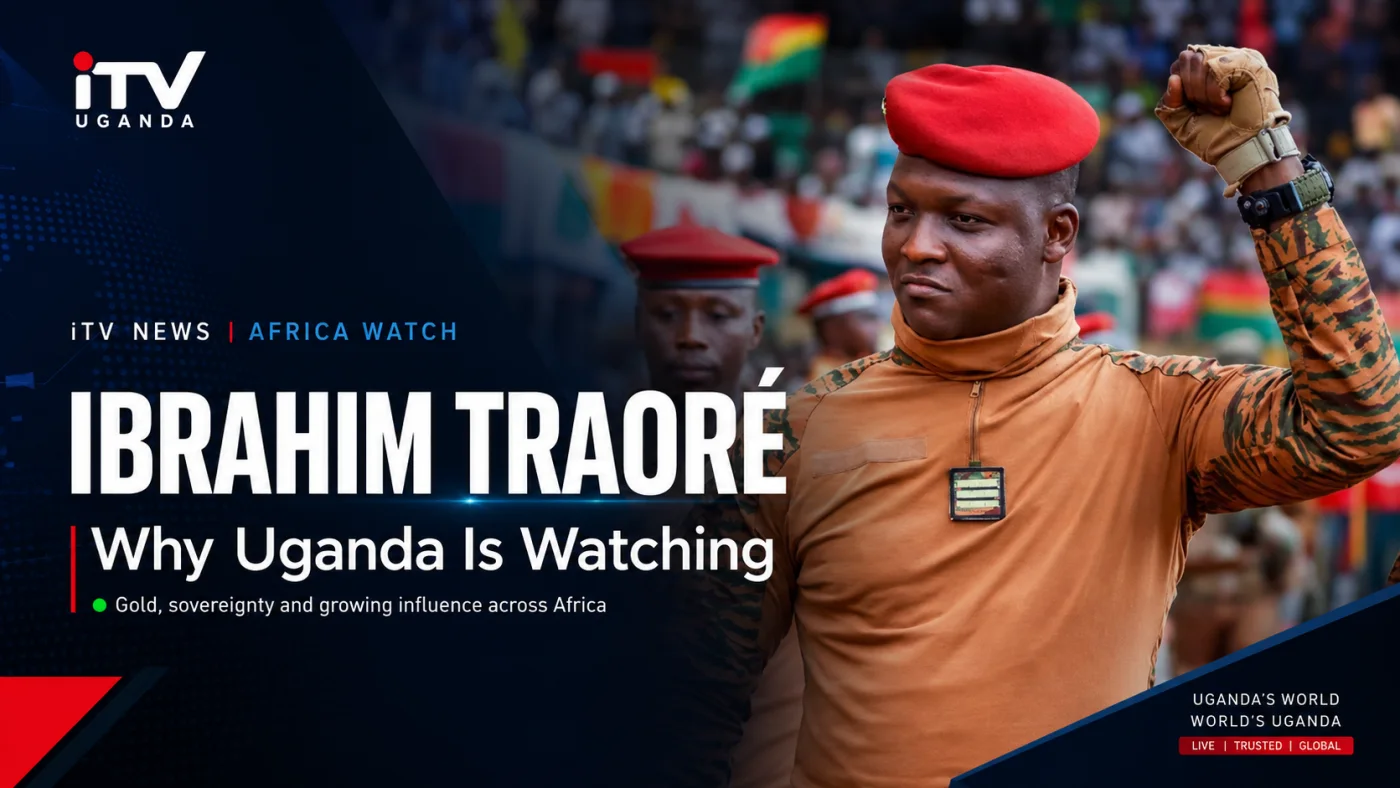
Why Ibrahim Traoré’s Gold Strategy Is Capturing Uganda’s Attention
Burkina Faso’s leader, Captain Ibrahim Traoré, is once again dominating conversations across African social media following reports that the West African country has earned approximately $18 billion from gold since he took power in 2022.
A post circulating widely online says Traoré’s administration has reclaimed foreign-controlled mines, expanded local processing and opened the country’s first industrial gold refinery. The post shared with iTV had attracted more than 104,000 views by July 18, showing the scale of public interest surrounding the Burkinabè leader.
For many Ugandans who have followed Traoré’s rise, the story represents more than gold. It feeds a wider debate about whether African countries are benefiting sufficiently from their natural resources—and whether governments should demand greater local ownership, processing and revenue retention.
But while Burkina Faso’s mining reforms and production gains are real, the viral $18 billion figure needs careful explanation.
Burkina Faso reports record gold production
Burkina Faso’s Ministry of Energy, Mines and Quarries reported in July 2026 that the country produced approximately 94 tonnes of gold in 2025, compared with about 60 tonnes in 2024.
The ministry said the mining sector generated more than 900 billion CFA francs in revenue by December 31, 2025. It attributed the growth partly to enforcement of the 2024 mining code, stronger state participation, tighter oversight and efforts to bring artisanal production into regulated channels.
Gold was already Burkina Faso’s largest export before Traoré took power. World Bank trade data shows that the country exported approximately $3.37 billion worth of gold in 2022, $3.51 billion in 2023 and $4.64 billion in 2024.
Those three full calendar years amount to approximately $11.52 billion in gross gold exports. However, Traoré only assumed power in late September 2022, meaning the entire value exported during 2022 cannot reasonably be attributed to his administration.
What does the reported $18 billion mean?
iTV has not found an official government breakdown showing that Burkina Faso’s treasury directly received $18 billion from gold after Traoré came to power.
The figure may represent an estimate of the gross commercial value of gold produced or exported, especially when record production from 2025 is included. That is different from government revenue.
Mining companies must first meet production costs, salaries, equipment expenses and other obligations. Government usually receives only a portion through taxes, royalties, dividends, licence fees and ownership stakes.
An analysis of the viral narrative found that the $18 billion claim had circulated widely without a publicly disclosed calculation or supporting dataset. It is therefore more accurate to describe the figure as reported or estimated, rather than confirmed government earnings.
Government takes control of two gold mines
The claim that Burkina Faso reclaimed two foreign-controlled gold mines is broadly correct, although the circumstances were more complicated than some social-media posts suggest.
In August 2024, the government reached an agreement to bring the Boungou and Wahgnion mines under state control. The arrangement followed a commercial and legal dispute involving Lilium Mining and London-listed Endeavour Mining.
Burkina Faso did not simply confiscate the mines without payment. Reuters reported that the government agreed to pay Endeavour $60 million, with additional royalty arrangements connected to future production.
The government has since sought financing to improve production at Boungou and Wahgnion. In June 2026, Burkina Faso’s legislature approved a loan worth more than 33 billion CFA francs to strengthen the two mines and reduce dependence on subcontractors.
Refinery claim also requires clarification
Traoré laid the foundation stone for Burkina Faso’s proposed national gold refinery in November 2023.
The planned facility was designed to process approximately 400 kilograms of gold per day, with an annual capacity of up to 150 tonnes. Officials said it would help the government monitor the purity and quantity of gold leaving the country while creating local processing jobs.
However, the official sources reviewed by iTV confirm the launch of construction, not the full commercial opening of the refinery.
Some online reports appear to confuse the planned refinery with Burkina Faso’s separate mining-residue processing plant. That plant began operations in January 2024 and later produced more than 93 kilograms of gold from residues previously surrendered to the state.
It is therefore safer to report that Burkina Faso launched construction of its first national refinery while expanding local gold-processing capacity.
Why Ugandans are following Traoré
Interest in Traoré within Uganda has been visible for more than a year.
In March 2025, the Daily Monitor published commentary presenting Burkina Faso’s infrastructure and domestic-development approach as a possible lesson for Uganda. The article reflected a wider discussion among Ugandans frustrated by repeated government programmes that do not always produce visible or lasting public infrastructure.
Uganda’s Chief of Defence Forces, Gen Muhoozi Kainerugaba, also publicly praised Traoré’s anti-imperialist position in May 2025 and invited him to visit Uganda. The comments gave further visibility to Traoré within Uganda’s political and online discussions.
Traoré’s youth, military image, public emphasis on sovereignty and willingness to challenge foreign mining arrangements have made him particularly attractive to Africans who believe the continent’s wealth has not sufficiently benefited its citizens.
His popularity also draws heavily from comparisons with Burkina Faso’s former revolutionary leader Thomas Sankara.
Popularity has also produced misinformation
Traoré’s popularity has made him one of the African leaders most frequently surrounded by false quotations, manipulated videos, exaggerated achievements and artificial-intelligence-generated images.
In 2025, an image circulated online claiming to show Ugandans marching in support of Traoré. Africa Check found that the image was generated using artificial intelligence and could find no evidence that the alleged demonstration had taken place in Uganda.
This does not mean Ugandan interest in Traoré is imaginary. It means genuine admiration is being mixed with content created to increase engagement, influence political opinion or present him as an almost flawless leader.
For iTV, that makes verification especially important.
A model of sovereignty—or a more complicated picture?
Traoré remains Burkina Faso’s head of state and leader of its military-led government. He seized power during a September 2022 coup, removing Paul-Henri Damiba, who had himself taken power through a coup earlier that year.
His government has pursued stronger control of gold, local production, agriculture and regional cooperation through the Alliance of Sahel States.
However, his record is not limited to economic nationalism. Burkina Faso’s government dissolved political parties in early 2026, and the country’s political transition has been extended while security challenges continue.
Ugandans following Traoré should therefore examine both sides: the genuine mining reforms and record production, as well as the questions surrounding military government, political freedoms, transparency and the long-term management of the country’s wealth.
The lesson for Uganda
The debate created by Burkina Faso’s gold sector is highly relevant to Uganda as the country develops oil, gold and other natural resources.
The central question is not whether every viral figure associated with Traoré is accurate. It is whether African governments can negotiate better agreements, strengthen local processing, enforce transparency and ensure that natural wealth produces visible improvements in education, health, employment and infrastructure.
Burkina Faso’s 94-tonne gold output is significant. Its movement towards stronger state participation is also real.
But the success of resource sovereignty will ultimately be measured not by viral headlines or the popularity of one leader, but by how much lasting benefit reaches ordinary citizens.
Reporting and analysis by Richardson Kyeyune — Chief, iTV News.